
Explore the Hobbit Tarot Cards
Explore the complete deck in classic tarot order. Choose a group to narrow the view, then select any card to open the larger carousel.

Aurica's notes: a small hero in a very large story
The first thing I notice about Hobbit Tarot is its twilight hush. Bare trees lean over blue water, mushrooms glow at the edge of paths, and Peter Pracownik's paintings feel like an old storybook opening a hidden door.
I like this deck for questions about courage in ordinary clothes. Its heroes look tired, curious, stubborn, tempted, and sometimes very small against the world. Terry Donaldson's familiar 78-card structure keeps that story energy usable in a real spread.
The scenes do not always echo Rider-Waite-Smith staging, so I read the title, notice the emotion, and test it against the card's traditional role and its neighbours. Take your time with these little painted journeys, and Hobbit Tarot can remind you that a brave next step is still brave even when it begins quietly.
Hobbit Tarot review: reading the road as well as the treasure
Hobbit Tarot works best as a narrative deck. It gives you paths, weather, companions, burdens, tools, and prizes, then asks you to decide what the visible moment means for the question at hand.
The review below looks closely at that reading voice, tests individual cards and four-card sequences, and explains where this unusual fantasy deck is most useful.
What makes Hobbit Tarot different?
This is a standard 78-card tarot deck with 22 Major Arcana and four fourteen-card suits. The earth suit is named Coins rather than Pentacles. That familiar skeleton is useful, but the pictures carry their meanings through landscape and narrative instead of repeating standard tableaus.
Many cards feel like moments caught between decisions. A road bends out of sight. A figure pauses beside dark water. Treasure shines in a cave where it may be blessing, burden, or bait. The deck is especially good at showing the emotional weather around a choice: excitement with a cold edge, comfort that has become cramped, loyalty tested by distance, and wisdom that asks for patience.
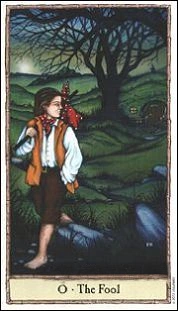
Card study
The Fool at the edge of home
A barefoot young traveller stands beneath a broad, dark-branched tree. Green hills roll behind him, and a round shadowed doorway sits in the earth at his back. His body faces the road while his head turns sideways, as if one last familiar sound has caught him before he leaves.
That backward glance changes the mood. This Fool is not blank innocence or reckless escape. He knows what he is leaving. Upright, I read him as a beginning chosen despite tenderness and nerves. In shadow, he can show a person romanticising the road while refusing to pack what the journey needs.
In an actual reading I would ask, "What can come with you, and what belongs to the doorway?" The answer may be practical: send the application, make the call, or take one step that cannot be mistaken for daydreaming.
Artwork, atmosphere, and reading voice
Pracownik works in deep blue, moss green, smoke grey, and flashes of amber. Moonlight is everywhere. Water and stone soften the line between a safe place and a threatening one, while red mushrooms and bright coins act like tiny visual bells. The paintings are not slick, and that is part of their charm. Brush texture and slightly theatrical figures make the deck feel handmade rather than digitally perfected.
The cards speak in scenes. I often begin with a plain sentence about what is happening: someone is waiting, guarding, hiding, carrying, or looking back. Then I bring in the traditional tarot meaning. That order stops a beloved fantasy theme from taking over the reading and keeps the answer connected to the question on the table.
Four-card reading
The shape of a quest
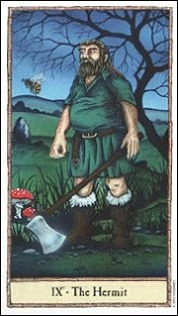
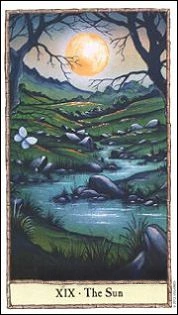
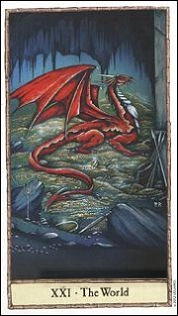
The Magician brings a moonlit guide and a raised staff; The Hermit places a bearded traveller beside a smaller companion and a grounded axe; The Sun opens into a green valley under a huge warm disc; The World ends in a cave with a red dragon curled around treasure. Together they show that a quest needs guidance, honest company, a clear glimpse of what life could become, and respect for the cost of the prize.

How Hobbit Tarot reads in practice
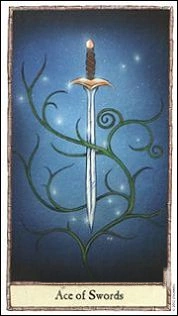
For a quick daily draw, this deck is direct. Name the action in the picture before reaching for a memorised keyword. A traveller looking over his shoulder gives a different answer from one charging ahead. A sword standing alone among curling vines feels different from a sword raised in battle.
Easy reading
Draw one card and finish the sentence, "Today I am being asked to..." Use the visible action as your verb.
Medium reading
Use three cards for Home, Road, and Companion. Read the middle card as the change required, not merely the obstacle.
Deep reading
Use five cards for Desire, Fear, Help, Price, and Return. This spread suits decisions where gaining something may alter the life you hoped to protect.
Reversals are optional. The artwork already contains plenty of tension, and the surrounding cards often reveal whether a scene is opening or closing. If you do use reversals, keep them practical: delayed action, misdirected loyalty, hidden cost, or a resource that cannot yet be reached.
Card study
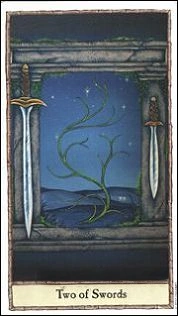
Two of Swords and the empty centre
Two tall swords stand at opposite sides of a stone-framed blue opening. Thin green tendrils curl through the middle, but no person occupies the scene. The symmetry feels formal, almost like a guarded door, while the open centre leaves room for something not yet named.
This is a beautiful change from the familiar blindfolded figure. The stalemate lives in the space between the blades. Upright, it can mark a pause that protects you long enough to think. In shadow, the pause becomes an arrangement you keep decorating because choosing would disturb it.
I would use this card to separate silence from indecision. Silence can gather information. Indecision repeats the same circle. Ask what fact would genuinely change the choice; if no new fact would, the reading is probably asking for a decision.
Reading relationships and group dynamics
Hobbit Tarot is at its warmest when several people affect the answer. Its courts feel like individuals in a travelling company rather than remote social ranks. One brings emotional sensitivity, another steadiness, another nerve, and another stewardship. In friendship, family, or work readings, that makes it easier to talk about the role each person is playing.
Watch for mismatched help. A fiery companion may offer movement when the querent needs rest. A caring figure may listen beautifully but avoid the practical decision. The cards become more useful when you ask whether the offered gift matches the present need.
Four-card reading
Companions on the road
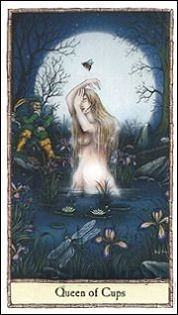
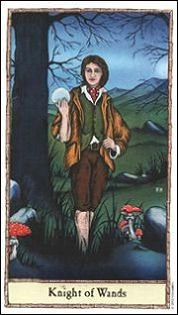
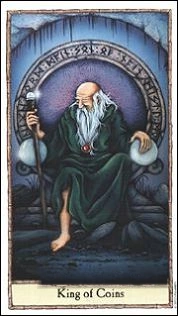
The Page of Cups stands alert beside water; the Queen of Cups rises pale and luminous beneath the moon; the Knight of Wands carries youthful motion through the hills; and the King of Coins sits inside a carved stone circle with the weight of responsibility around him. Read them as Message, Empathy, Courage, and Stewardship. Which companion is present, and which one is missing?

Who will feel at home with this deck?
This deck suits readers who enjoy fantasy illustration, narrative spreads, moonlit colour, and cards that invite conversation. It also works well for journal readers who like to turn one image into a scene and then ask what happens next.
A complete beginner can use it because the titles and structure are familiar, but I would keep a basic tarot guide nearby. Several images depart sharply from common Rider-Waite-Smith compositions. That difference is interesting, though it means the picture alone may not teach the conventional meaning.
Readers who want crisp modern linework, bright daylight, or instantly recognisable RWS clones may find the deck murky. The source artwork is also visibly of its era. Buy it for its storybook mood and odd corners, not for minimalist polish.

Card study
Eight of Coins beside the cold stream
A red-haired figure in green kneels at the edge of blue water, hemmed in by stones and bare trees. A pale light glows in the distance. The body is turned away from us and folded toward the task, so the card feels private and absorbed rather than performative.
The scene gives work a quiet, almost wintry quality. Upright, the Eight of Coins is patient practice: learning by returning to the same small action until the hands understand it. In shadow, concentration can shrink into isolation, or perfectionism can keep the work forever beside the stream instead of letting it travel.
For love, this can be trust repaired through repeated behaviour. For work or study, it favours rehearsal, editing, apprenticeship, and useful feedback. Progress may be hard to see from one day to the next, but the craft is accumulating.
What to know before buying
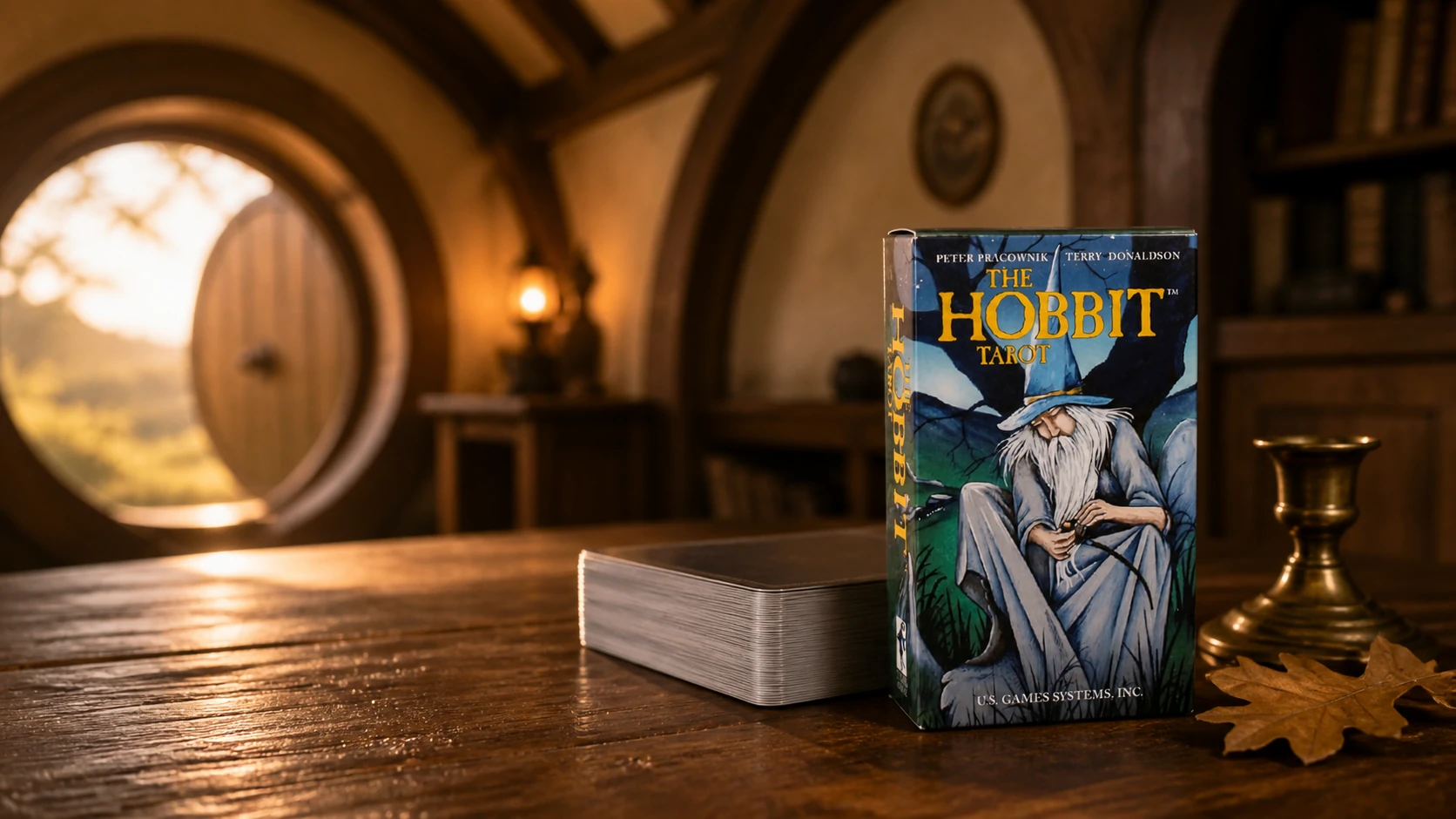
The box reference identifies Peter Pracownik and Terry Donaldson and carries the U.S. Games Systems name. The deck uses the traditional 78-card count, with Coins as the earth suit. Check the product listing carefully if you are buying second-hand, because older decks can vary in box wear, guidebook condition, and whether every card is present.
The Amazon button on this page leads to the product detail page rather than a search result. Availability and price can change, so confirm the seller, language, contents, and condition before ordering. TarotFans may earn a commission from qualifying purchases without changing your price.
Four-card reading
Treasure, labour, and enough
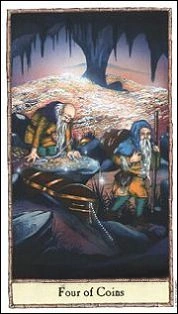
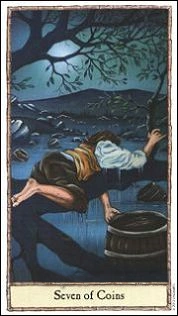
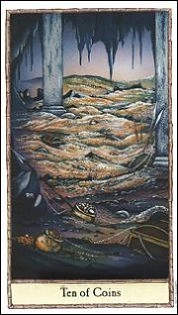
The Ace of Coins suspends a bright geometric disc above a dark valley. The Four places figures over a glittering hoard. The Seven shows a person straining beside water and a heavy barrel, while the Ten leaves us with an almost empty cave and scattered riches. The sequence asks a blunt question: does the thing you want support a life, or has the pursuit become the life?

Aurica's golden rule
Read the road before the treasure
When a Hobbit Tarot card shows a prize, look at the path around it. Is the ground safe? Who travelled with you? What did the journey ask you to become? This deck rarely treats reward as a simple yes. The setting tells you whether the treasure is nourishment, responsibility, temptation, or trouble.
I use the same rule with difficult cards. Before deciding that a dark forest means danger, look for the door, stream, moon, companion, or tool. The picture often contains its own way forward, though it may be smaller than the dramatic answer we hoped to receive.
Four-card reading
A clear answer in a dark passage
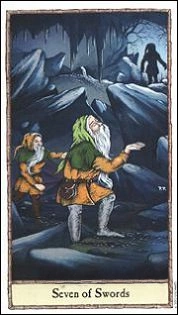
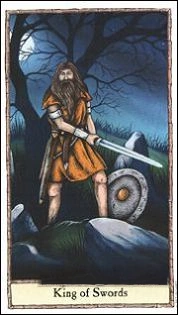
The Ace of Swords gives a clean blade wrapped in living green lines. The Seven moves through a rocky passage where not every figure is easy to read. The Knight advances with shield and raised sword, and the King stands planted beneath the moon. Use them as Truth, Evasion, Action, and Judgment when a decision has become tangled.

Final thoughts
Hobbit Tarot is not a tidy deck. Some pictures are bright with promise; others feel cramped, cold, or deliciously peculiar. That unevenness gives it a human pulse. It reads best when you are willing to stay with the scene for a moment and notice where the light is coming from.
I would choose it for questions about leaving home, carrying responsibility, choosing companions, and deciding what a prize is worth. If you love old fantasy art and want a tarot deck that behaves like a pocket-sized quest, it has real personality. If you want every meaning shown in familiar RWS shorthand, expect a learning curve.
Hobbit Tarot FAQ
Is Hobbit Tarot a complete tarot deck?
Yes. It follows the standard 78-card structure: 22 Major Arcana and 56 Minor Arcana cards across Wands, Cups, Swords, and Coins.
Is Hobbit Tarot beginner-friendly?
The familiar card titles make it approachable, but many scenes differ from Rider-Waite-Smith imagery. Beginners will get more from it with a basic tarot reference and a willingness to study each picture.
Does the deck use Pentacles?
The earth suit is titled Coins. It still covers material life, resources, work, security, the body, and the practical consequences of choices.
Who created Hobbit Tarot?
Peter Pracownik created the artwork, and Terry Donaldson wrote the accompanying guide booklet. U.S. Games Systems published the English-language deck in 2012.
What kinds of readings suit this deck?
It is especially expressive for life transitions, courage, friendship, group roles, temptation, creative work, and questions about what a goal may cost.
Where can I see the cards before buying?
The gallery near the top of this page lets you browse every card in order, filter by Major Arcana or suit, and open each image in the larger carousel.


