
Visconti-Sforza Tarot Card Gallery
Explore the available Visconti-Sforza artwork in one continuous gallery. Select any card to open the larger Lightbox, then use the previous and next controls to move through the deck.
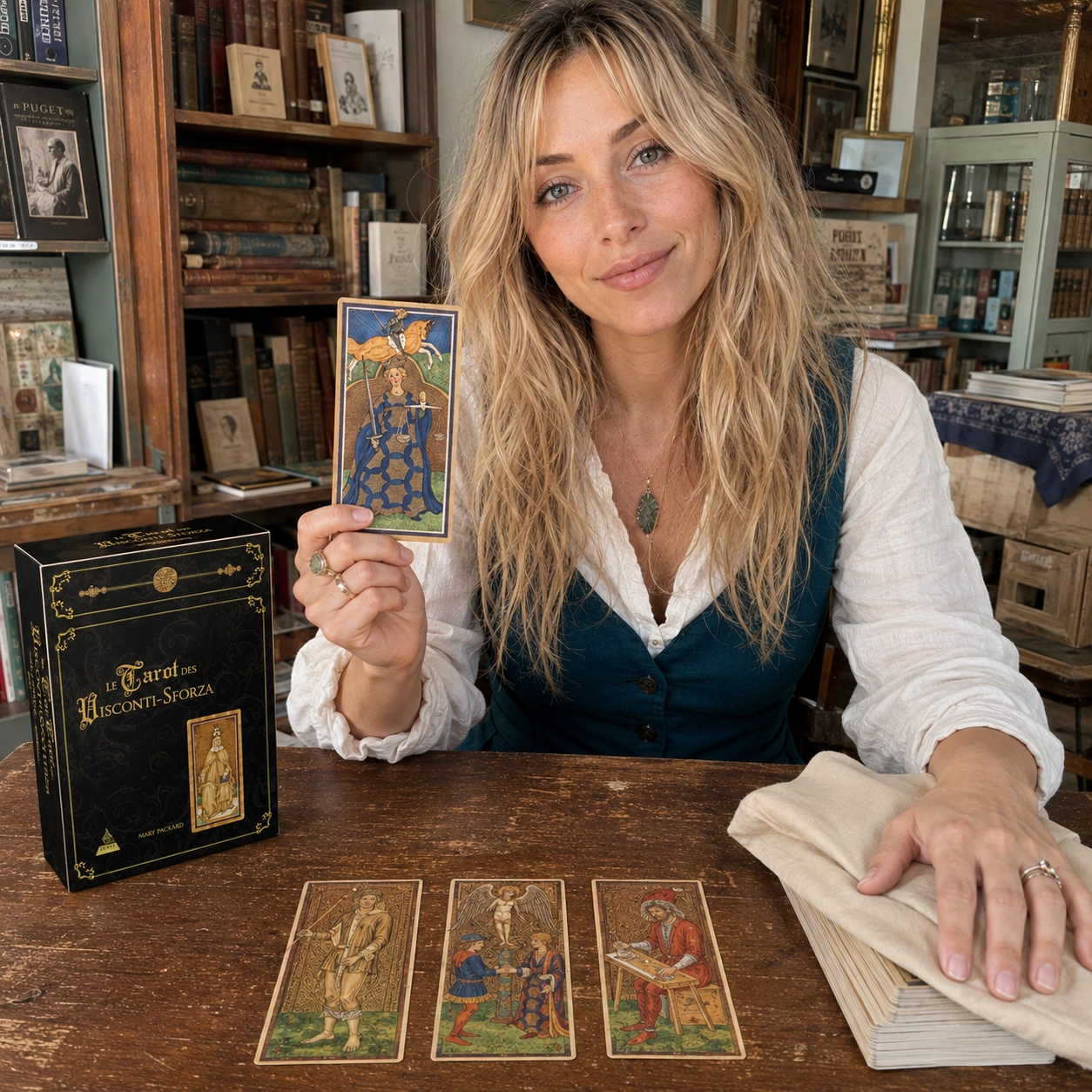
A note from Aurica
I feel the hush of an old Milanese hall when I lay these cards down. Gold does not sparkle here like party light; it glows like a chapel wall that has watched generations make promises, inherit duties, and quietly long for another life. The figures often hold themselves with courtly restraint, so I slow my breathing and look for the smallest rebellion: a turned shoulder, an unguarded foot, a horse moving above a seated judge.
Justice is the card I keep returning to. Her blue gown feels steady and ceremonial, yet the rider overhead brings movement into the stillness. In a reading, I ask what must remain balanced and what can no longer stay frozen merely because tradition approves of it. Then I test that first feeling against Justice’s familiar call for fairness, consequence, and clean decisions.
The Fool, Lovers, and Magician make a lovely conversation beside her. The Fool slips outside rank, the Lovers place a tender choice beneath a watchful angel, and the Magician turns craft into visible action. I notice who has permission, who is being observed, and whose hands are free to shape events. Nearby cards tell me whether the story is about courage, obligation, intimacy, or the price of being seen.
The pip cards ask for a different kind of listening. Repeated coins, cups, swords, and batons create rhythm before they create a scene, so I read number, suit, spacing, and ornament together. Rather than forcing a modern drama onto them, I let their pattern set the emotional weather, then bring the message down to one practical choice the reader can make today.
This is a deck I reach for when family history, reputation, vows, or inherited roles sit heavily around a question. Its beauty can be solemn, but never empty: the gold holds a small sunrise inside every difficult choice. May these old courtly figures remind you that you can honour what shaped you while still choosing your own bright next step.
The Golden Tarot – The Visconti-Sforza Deck is Mary Packard’s guide to one of tarot’s most important visual lineages: the lavish, hand-painted cards associated with the Visconti and Sforza courts of fifteenth-century Milan. This is not Kat Black’s collage-based Golden Tarot, nor Liz Dean’s deck, nor the Golden Tarot of the Renaissance. It is a history-rich Visconti-Sforza edition whose gold grounds, courtly figures, heraldic details, and emblematic suit cards carry you much closer to tarot’s early Italian world.
Quick verdict
This is a beautiful choice for readers who want tarot with genuine Renaissance lineage rather than a modern deck wearing a medieval costume. Its strongest qualities are historical atmosphere, restrained human expression, ornate gold, and a suit system that reads through emblems, repetition, rank, costume, and gesture. It asks you to slow down.
It is less effortless for readers trained only on scenic Rider-Waite-Smith minors. Many pip cards communicate through arranged cups, coins, swords, and batons rather than fully illustrated everyday scenes. That can feel sparse at first, but it also encourages numerology, elemental reading, and close observation.

Card moment
The Fool: an outsider at the edge of courtly order
This Fool stands apart from the deck’s enthroned rulers and richly dressed court figures. His pale, loosely draped clothing, bare legs, feathered headpiece, and exposed stance make him look socially unguarded against the burnished background.
In a reading, he can mark freedom from inherited rank as well as the vulnerability of having no fixed place. Upright, he asks for honest movement beyond convention; in shadow, he warns that innocence without protection can become exclusion or spectacle.
Edition at a glance
Mary Packard edition facts
- Author
- Mary Packard
- Spanish title
- El Tarot de Oro: La baraja Visconti-Sforza
- Spanish translator
- Herminia Bevia
- Publisher and year
- Akal, 2014
- Guide length
- 144 pages
- ISBN
- 8496669882 / 9788496669888
Why the Visconti-Sforza cards matter
“Visconti-Sforza Tarot” is a collective name for surviving groups of luxury cards commissioned in and around fifteenth-century Milan. No complete historical pack has survived intact. The remaining cards are distributed among museums, libraries, and private collections, and modern editions complete the reading sequence by reproducing or reconstructing what is missing.
The cards began life in a courtly culture where tarot was still associated with trionfi, or triumph cards, and with game play. Their imagery later became foundational to the visual language of tarot. The famous surviving groups include the Pierpont Morgan-Bergamo, Cary-Yale, and Brera-Brambilla sets. Across them you encounter gilt grounds, precious-looking surfaces, heraldic emblems, formal dress, processions, virtues, rulers, and family symbolism tied to Renaissance Milan.
That history changes the reading experience. These images do not feel like illustrations of modern psychological keywords. They feel ceremonial. Rank and posture matter. A raised throne, a bowed head, an armored figure, a repeated coin, or the direction of a horse can carry as much weight as a facial expression.
Four-card reading
Choice, counsel, law, and authority
The Lovers, Hierophant, Justice, and Emperor form a courtly decision spread: what the heart chooses, what tradition advises, what fairness requires, and where final responsibility sits.


Artwork: gold, court life, and emblematic suits
The requested 78-card video walkthrough shows the deck’s identifying visual grammar clearly. Cups appear as ornate chalices; coins as repeated circular emblems; swords as long interlaced blades; and batons as crossed or arranged staffs. Court figures wear period clothing and armor, while many trump images stand against dark, burnished, or gilded-looking grounds.
The palette is warmer and earthier than many modern “gold” decks. Reds, greens, muted blues, parchment tones, and metallic surfaces carry the atmosphere. The people are formal rather than theatrical. Their restraint makes small details meaningful: who faces whom, which object is held, how clothing signals rank, and whether a figure is moving, seated, blessing, judging, or waiting.
Card moment
The Lovers: union beneath a higher witness
The pair meet beneath a winged figure, while their patterned garments and formal poses make the encounter feel public and consequential rather than casually romantic. The small central gesture carries unusual force because the surrounding composition is so restrained.
In a reading, this Lovers card asks what a bond establishes in the wider world. It can affirm mutual recognition and chosen alliance; in shadow, it exposes a promise shaped more by family, status, or expectation than by genuine consent.
Reading approach
How this deck reads in practice
Start with rank and relationship
Notice thrones, armor, mounted figures, attendants, and the direction of each gaze. Courtly hierarchy often reveals who has authority, who is asking permission, and who carries responsibility.
Read the pips structurally
For the numbered suits, combine number, element, symmetry, interruption, and ornament. The arrangement of emblems matters more than a staged narrative.
Let gold change the tone
Gold can suggest blessing, inheritance, prestige, sacred duty, or the burden of appearances. Ask whether the card’s splendor represents value, status, or both.
Keep spreads compact
Three to five cards give the formal imagery room to breathe. A useful spread is: what is inherited, what is expected, what is changing, and what restores balance.
Four-card reading
Shadow, uncertainty, ending, and release
The Devil, Moon, Death, and Tower create a direct shadow-work sequence: name the bond, sit with what is unclear, allow the necessary ending, and release the structure that can no longer stand.


Best questions for the Visconti-Sforza deck
This deck excels with questions about lineage, family roles, social expectations, reputation, vows, inheritance, leadership, patronage, and the tension between private desire and public duty. It can also be powerful for creative work because its images ask how beauty, skill, and status are made visible.
For a one-card pull, try three prompts: What role am I performing? What symbol has the most authority in this image? What action would honor the card without becoming trapped by appearances? These questions keep the historical atmosphere connected to present-day choices.
Card moment
The Moon: uncertainty held inside a formal world
Two exposed figures lift a large circular image of a fortified city beneath a gold-toned field. The contrast between vulnerable bodies and enclosed architecture makes the card feel like a meditation on what is imagined, protected, or projected at night.
In a reading, this Moon favors patient observation over premature certainty. Upright, it opens intuition and symbolic dreaming; in shadow, it asks whether fear is turning a distant structure into something larger and more absolute than it is.
Is it beginner-friendly?
Yes—with the right expectation. The major arcana and court cards provide strong figures and roles, but the pip cards may require more numerology and suit knowledge than a fully scenic Rider-Waite-Smith deck. Mary Packard’s guide is valuable here because this is an edition to study rather than skim.
Beginners who love art history, Renaissance symbolism, or Marseille-style reading may bond with it immediately. Readers who rely on modern facial expression and literal scenes may prefer to learn it beside a basic tarot reference.
Four-card reading
Practice, learning, care, and exchange
The Eight, Page, Queen, and Six of Pentacles form a grounded material reading: the craft being repeated, the lesson still opening, the resources that need stewardship, and the balance between giving and receiving.


Pros and cons
| Pros | Cons |
|---|---|
| Direct connection to one of tarot’s earliest and most influential visual traditions. | Different language editions and product formats can make listings confusing. |
| Rich gold grounds, courtly dress, heraldry, and historical atmosphere reward close looking. | Pip cards are less narrative than Rider-Waite-Smith scenes and require structural reading. |
| Excellent for lineage, duty, status, vows, family patterns, and long-term decisions. | No complete fifteenth-century deck survives, so modern editions necessarily complete missing material. |
| Mary Packard’s 144-page guide gives the edition useful historical and interpretive context. | The formal artwork can feel emotionally restrained if you prefer bright contemporary decks. |
Four-card reading
Love, memory, care, and renewal
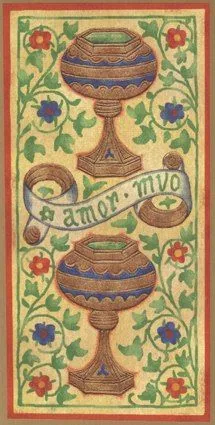
The Two, Six, Queen, and Ace of Cups move from mutual recognition through remembered feeling and mature emotional care toward the clean beginning that becomes possible when the past is handled honestly.


Final thoughts
Mary Packard’s Visconti-Sforza edition deserves to be judged on its own terms. It is not “Golden Tarot” as a generic style label and it is not the Kat Black deck. Its identity comes from the surviving luxury cards of Renaissance Milan and from the modern editorial work needed to make that historical tradition usable as a complete reading deck.
Choose it if you want gold with historical substance: formal figures, heraldic order, emblematic suits, and a reading voice shaped by ancestry, rank, duty, and beauty. The all-78-card video above is the best way to test whether that quieter visual language speaks to you before buying.
The Golden Tarot – Visconti-Sforza FAQ
Is this the same Golden Tarot created by Kat Black?
No. This review is specifically for Mary Packard’s Visconti-Sforza title. Kat Black’s Golden Tarot is a separate modern collage deck and needs its own page.
What is the exact Spanish edition called?
It is catalogued as El Tarot de Oro: La baraja Visconti-Sforza, by Mary Packard, translated by Herminia Bevia, published by Akal in 2014. Its ISBN-10 is 8496669882 and ISBN-13 is 9788496669888.
Are all 78 cards original fifteenth-century survivors?
No complete historical Visconti-Sforza pack survives. Modern complete editions reproduce surviving cards and complete missing material so the deck can be used as a 78-card tarot pack.
Does the deck read like Rider-Waite-Smith tarot?
Not exactly. The numbered suits are more emblematic and less scenic, so number, suit, repetition, symmetry, rank, and gesture do more of the interpretive work.
Can I preview all 78 cards?
Yes. The embedded TarotFans video at the top of this review presents all 78 cards from the Visconti-Sforza deck walkthrough.
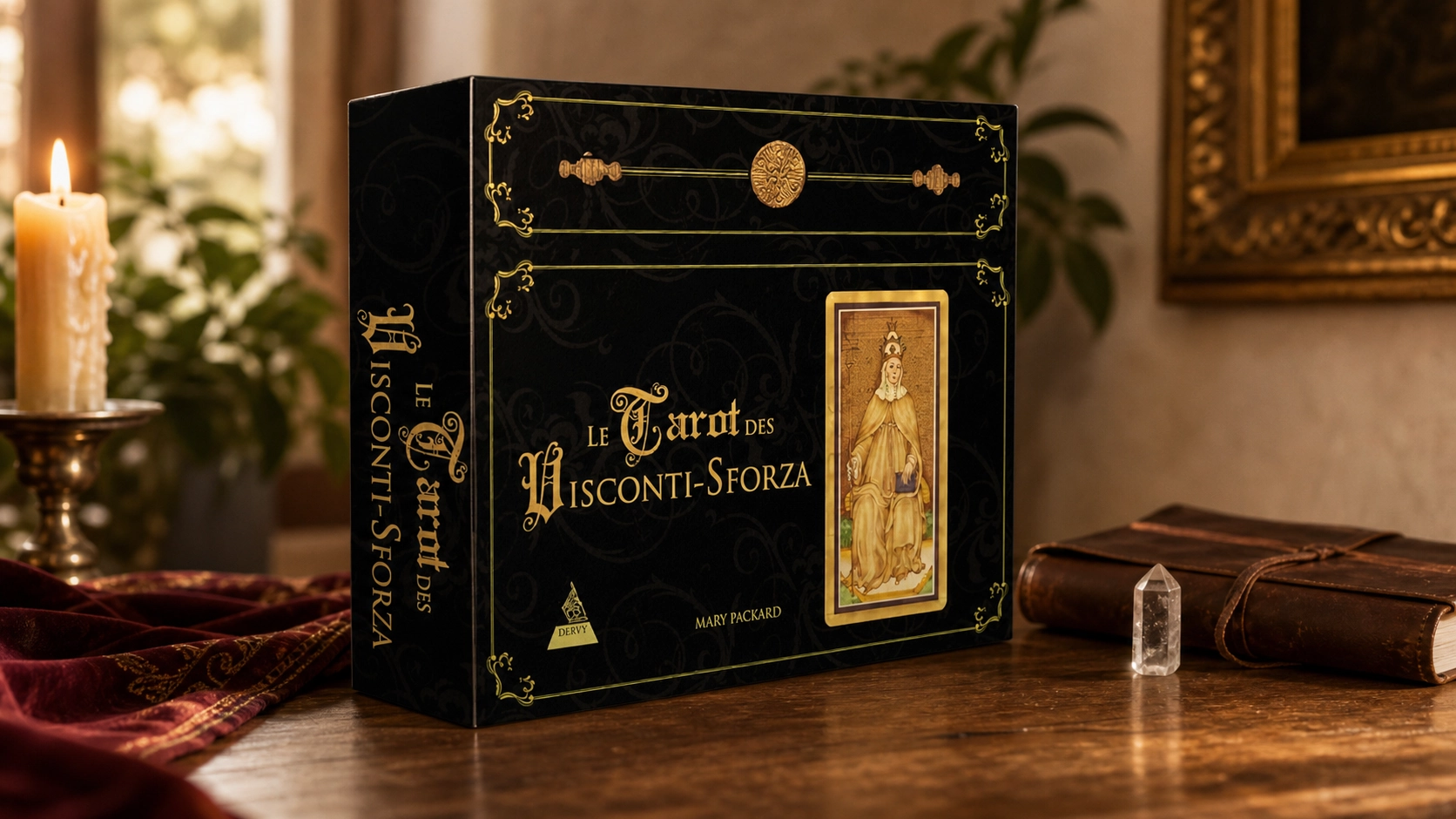
Why does the product image say “Le Tarot des Visconti-Sforza”?
The supplied product reference is a French-branded Mary Packard edition, while the linked Amazon listing is Spanish. The underlying Visconti-Sforza subject is the same, but language, publisher branding, and packaging can vary.


