The complete deck
Explore the Medieval Cat Tarot Cards
Step through Lawrence Teng’s verified card artwork in the deck’s own order. Choose a family or select any card for a larger, keyboard-friendly view.
Showing all cards
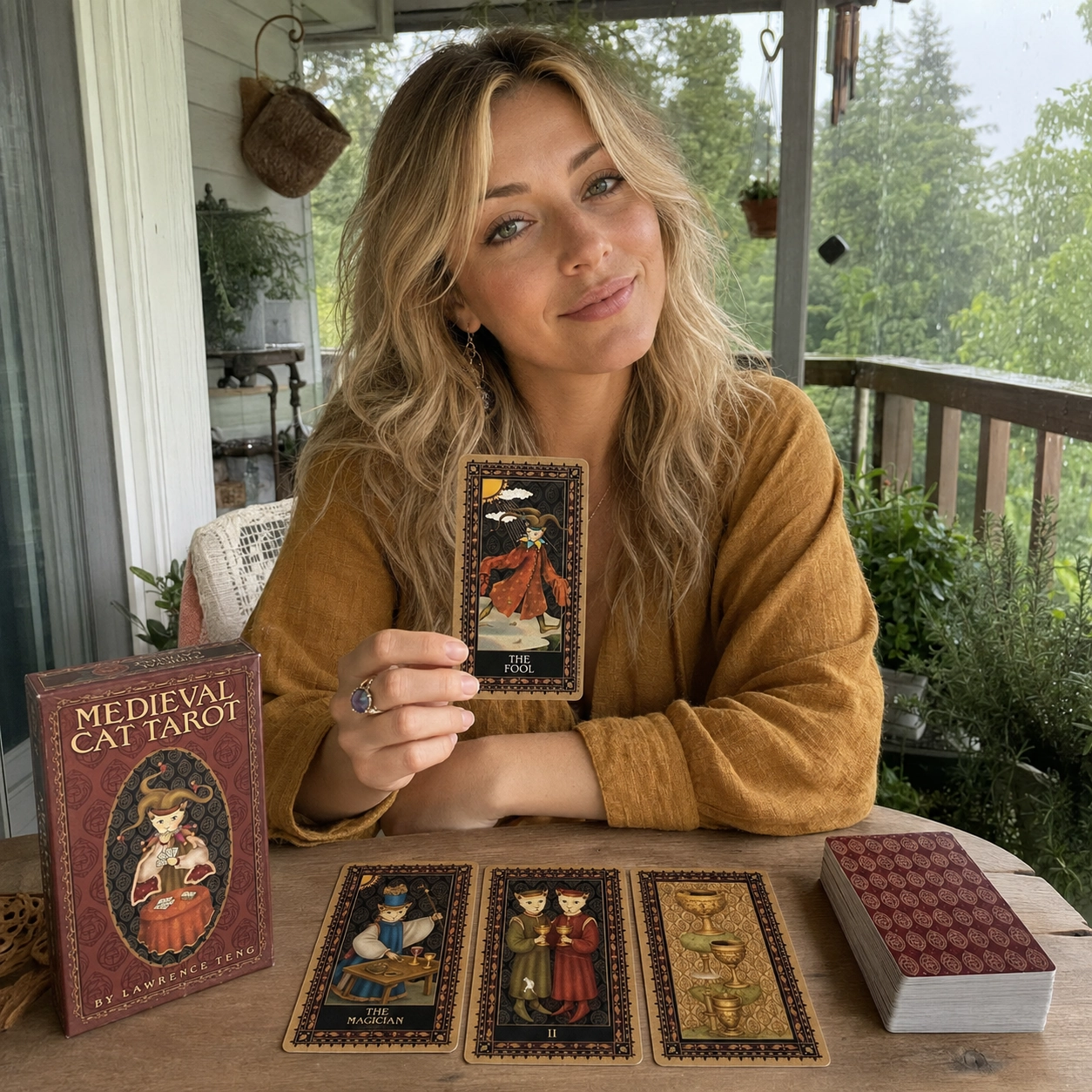
Aurica’s Notes
I love the contrast here: every cat arrives dressed for court, yet the glance beneath the velvet is unmistakably feline. A lifted chin feels proud; a sideways look feels wary. One tiny paw can change the whole emotional weather.
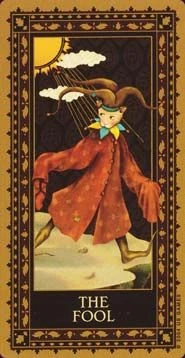
I begin with that expression, then let the Renaissance setting show what is protected or politely left unsaid. The Fool’s red robes move like a gust, while The Popess stands so still that her staff feels like a boundary. Together they ask: is this the moment to wander, or to hold your ground?
The deck is playful without becoming shallow. I test my first feeling against the card’s traditional role and the surrounding spread. For health or money questions, I use tarot for reflection alongside qualified care or advice, never in place of it.
The short review
A court of cats with something human to say
Medieval Cat Tarot turns the familiar seventy-eight-card structure into a small, watchful kingdom. Lawrence Teng’s cats wear Renaissance gowns, hats and armour, but their feline faces keep the scenes from becoming stiff. Pride, curiosity, caution and appetite flicker through their eyes, making the deck especially good at questions about social roles and the feelings hidden beneath good manners.
Gina M. Pace and Lawrence Teng are credited by U.S. Games as the deck’s authors, with Teng as its artist. The structure remains recognisable, while the deck keeps its own printed language: The Popess and The Pope appear in the Majors, and the earthy suit is Coins. That matters when learning the deck, because its old-world vocabulary is part of its charm rather than an error to be modernised away.
How the pictures speak in a reading
The Majors often feel like portraits from a candlelit hall: one figure, one deliberate pose, one emotional note held long enough for you to notice it. The Minors become more emblematic, setting small cat figures among cups, coins, swords and curling botanical patterns. Read the card title first, then notice the posture or arrangement that makes this version warmer, sharper or more guarded.
This is not a deck that needs a theatrical prediction. It works beautifully when the question is clear and the next step is small: what deserves attention, which role has become uncomfortable, or where politeness is concealing a more honest need.
Card study
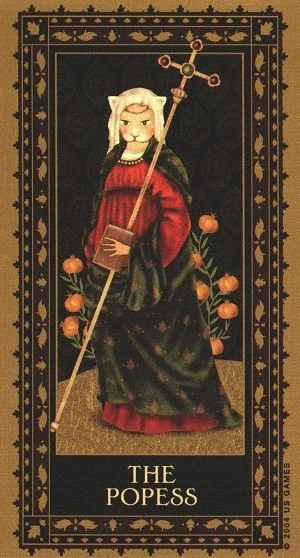
The Popess — quiet authority behind the veil
The Popess stands front-facing in deep red and dark green, one hand holding a tall staff topped with a delicate crossed form. Orange flowers rise on either side, but her pale face remains composed and unsmiling. The symmetry makes the whole card feel guarded, as if you have entered a chamber where listening matters more than speaking.
In a reading, that stillness can signal knowledge that is present but not ready to be displayed. Upright, she asks for patience, privacy and trust in what you already sense. In shadow, the same reserve can become secrecy or emotional distance. I would ask: what becomes clearer when you stop pressing for an immediate answer?
Beginner-friendly, with an old-world accent
New readers have a strong handrail here: the deck follows the familiar Major and Minor Arcana structure, and the cards keep clear titles or numbers. The changes are easy to learn. The Popess corresponds to the High Priestess, The Pope to the Hierophant, and Coins take the place often called Pentacles.
Try a one-card pull for seven days. Write down the cat’s expression, the strongest object or colour, the traditional meaning, and one action you can take before tomorrow. That little ritual teaches you to balance intuition with structure instead of choosing one and abandoning the other.
Four-card moment
Four faces of inner weather
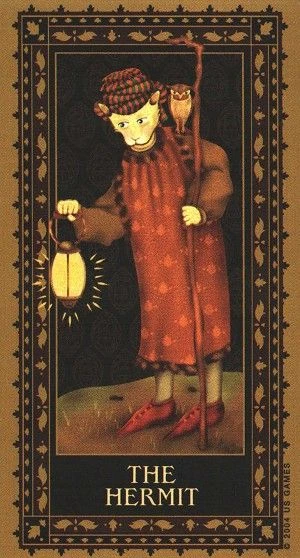
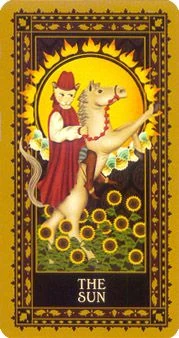
The Fool, The Hermit, The Moon and The Sun move from restless possibility through solitude and uncertainty into open warmth. Together they make a gentle map for checking where your energy truly sits today.

Love, friendship and the masks we wear
These courtly cats are excellent companions for relationship readings because they make social performance visible. A formal pose may show genuine devotion, but it can also reveal the effort of keeping up appearances. Look at which figure leans in, who turns aside, and whether a gift or gesture feels freely offered.
Ask questions that leave room for agency: what needs tenderness, what boundary would create safety, and what honest conversation is hiding beneath the polished surface? The deck’s humour helps difficult feelings breathe, while its stately compositions keep the reading from sliding into gossip.
Card study
The Moon — uncertainty in a pale gold crescent
A robed cat stands beneath an enormous gold crescent, head lowered and arms folded close. Coloured drops fall through the black sky, and a pale vessel waits near the hem of the orange gown. The figure looks contained rather than panicked, giving uncertainty a private, inward mood.
In practice, this Moon does not demand that you solve every mystery. It asks you to notice what fear is colouring and what your body already knows. Upright, it supports patient observation and dreamlike intuition; in shadow, it warns against treating a feeling as proof. Check the surrounding cards before naming the story.
Work, money and creative choices
For practical questions, the patterned Minors can be wonderfully direct. Coins emphasise stewardship, patience and what can be held in the hand. Swords reveal friction and decision. Cups show how connection is being offered or withheld, while Wands bring appetite, movement and the nerve to begin.
For an easy reading, draw one card for the next useful action. For a medium reading, use three cards for role, hidden pressure and response. For a deeper reading, compare the repeated suit symbols with the cats’ expressions: the object tells you the arena, while the face tells you how the situation is being lived.
Four-card moment
The language of care
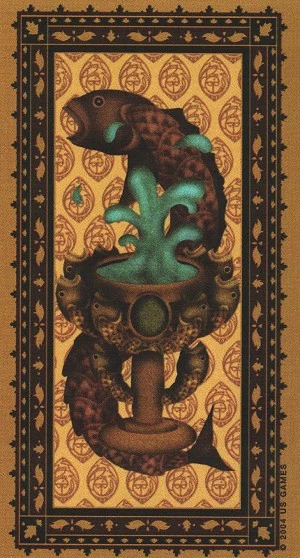
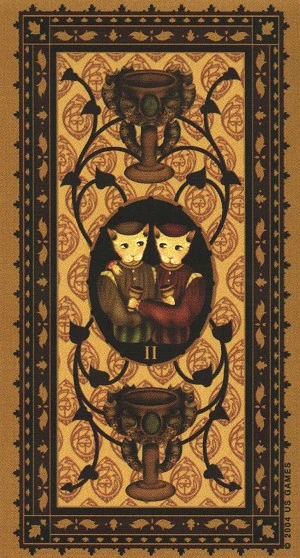
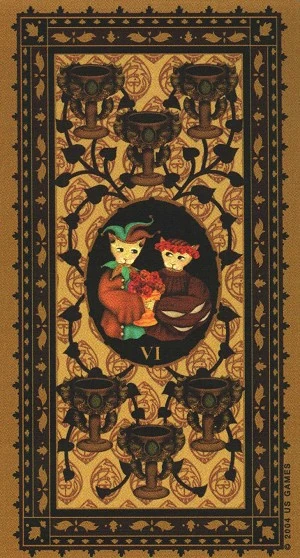
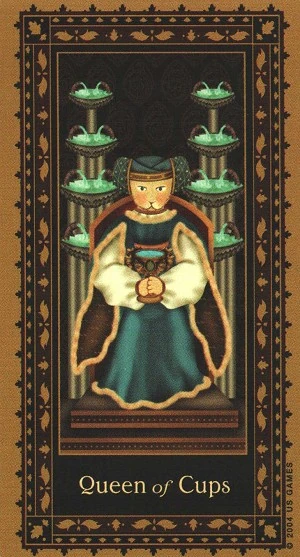
The Ace, Two, Six and Queen of Cups show feeling as an overflowing source, a meeting, a shared memory and mature containment. Read them together when you need to distinguish affection from the way affection is actually expressed.
Who will feel at home with this deck?
Medieval Cat Tarot is a lovely fit for cat lovers, visual readers and anyone drawn to Renaissance ornament without wanting a museum-piece deck. Its expressions are memorable enough for intuitive work, while the traditional structure keeps study notes and standard tarot books useful.
It may be less comfortable if you need modern human scenes, photographic realism or heavily illustrated narrative Minors. The best test is not whether you like cats in general. It is whether these particular watchful faces make you curious enough to keep looking.
Card study
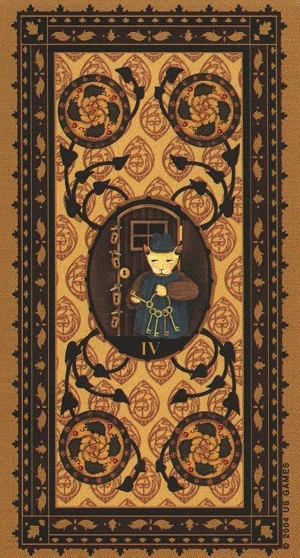
Four of Coins — safety behind a locked door
Four ornate coins anchor the corners while a small blue-clad cat stands inside a dark arched doorway, hands held close around a key-like object. The repeating vines and heavy door make the scene feel protected, but also enclosed.
This is security with a threshold. Upright, it can honour saving, boundaries and careful stewardship. In shadow, the same locked feeling can become fear of sharing or movement. In a money reading, ask what truly needs protection and what has simply become difficult to release.
What I like most—and what to know before buying
I like the deck’s emotional precision. A cat can look dignified and mildly unimpressed at the same time, which is often closer to real life than a single dramatic expression. The warm tan grounds, black floral frames and burgundy accents also hold a spread together beautifully.
Before buying, know that this is the U.S. Games edition with seventy-eight cards measuring about 2.5 by 4.75 inches. Its printed titles include The Popess, The Pope and Coins. Check the listing photographs and ISBN 978-1-57281-476-9 so you do not accidentally compare it with an imitation or another cat-themed deck.
Four-card moment
From nurture to self-possession
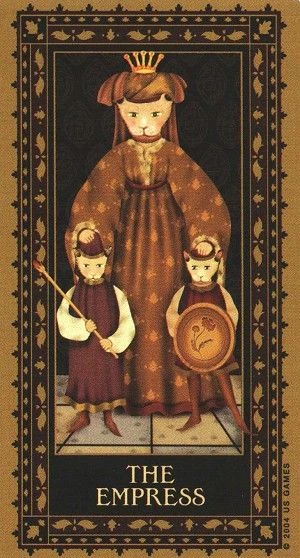
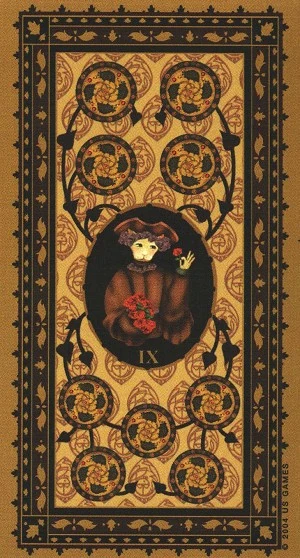
The Empress, Queen of Cups, Four of Coins and Nine of Coins trace a practical arc: care for what matters, hold feeling wisely, create a safe container, then enjoy what patient attention has grown.
The Medieval Cat golden rule
Read the manners, then read the cat. Begin with the formal role shown by the clothes, throne, staff or suit symbol. Then notice the animal truth beneath it: the alert ears, lowered gaze, guarded paws or sudden movement. The meaning often lives in the distance between the part being played and the feeling that refuses to stay hidden.
Final thoughts
Medieval Cat Tarot has a rare balance of elegance and mischief. It can hold a serious question without losing warmth, and it rewards readers who notice posture and atmosphere as carefully as symbols. If its little court makes you smile and then wonder what a figure is really thinking, the deck is already doing its work.
For another creature-led reading world, explore the Mystical Cats Tarot review. If you want a darker woodland mood, try the Tarot of the Secret Forest review.
Before you choose
Medieval Cat Tarot FAQ
Who created Medieval Cat Tarot?
U.S. Games credits Gina M. Pace and Lawrence Teng as the authors, with Lawrence Teng as the artist. The box front carries Teng’s name, while the official publisher record preserves both author credits.
Is Medieval Cat Tarot a complete 78-card deck?
Yes. It contains the standard seventy-eight-card framework: twenty-two Major Arcana and fifty-six Minor Arcana cards across Wands, Cups, Coins and Swords.
Is Medieval Cat Tarot good for beginners?
It can be. The structure is traditional and the titles are clear, but beginners should learn that The Popess corresponds to the High Priestess, The Pope to the Hierophant, and Coins to Pentacles.
What kinds of readings suit this deck?
It is especially expressive for relationships, social roles, boundaries, daily guidance and creative questions. The cats’ posture and gaze add emotional nuance without replacing the card’s traditional function.
What do the card backs look like?
The exact edition uses a symmetrical burgundy back with repeated gold leaf-like emblems. Its reversible design supports readings with reversed cards.
How can I check that a listing is the right edition?
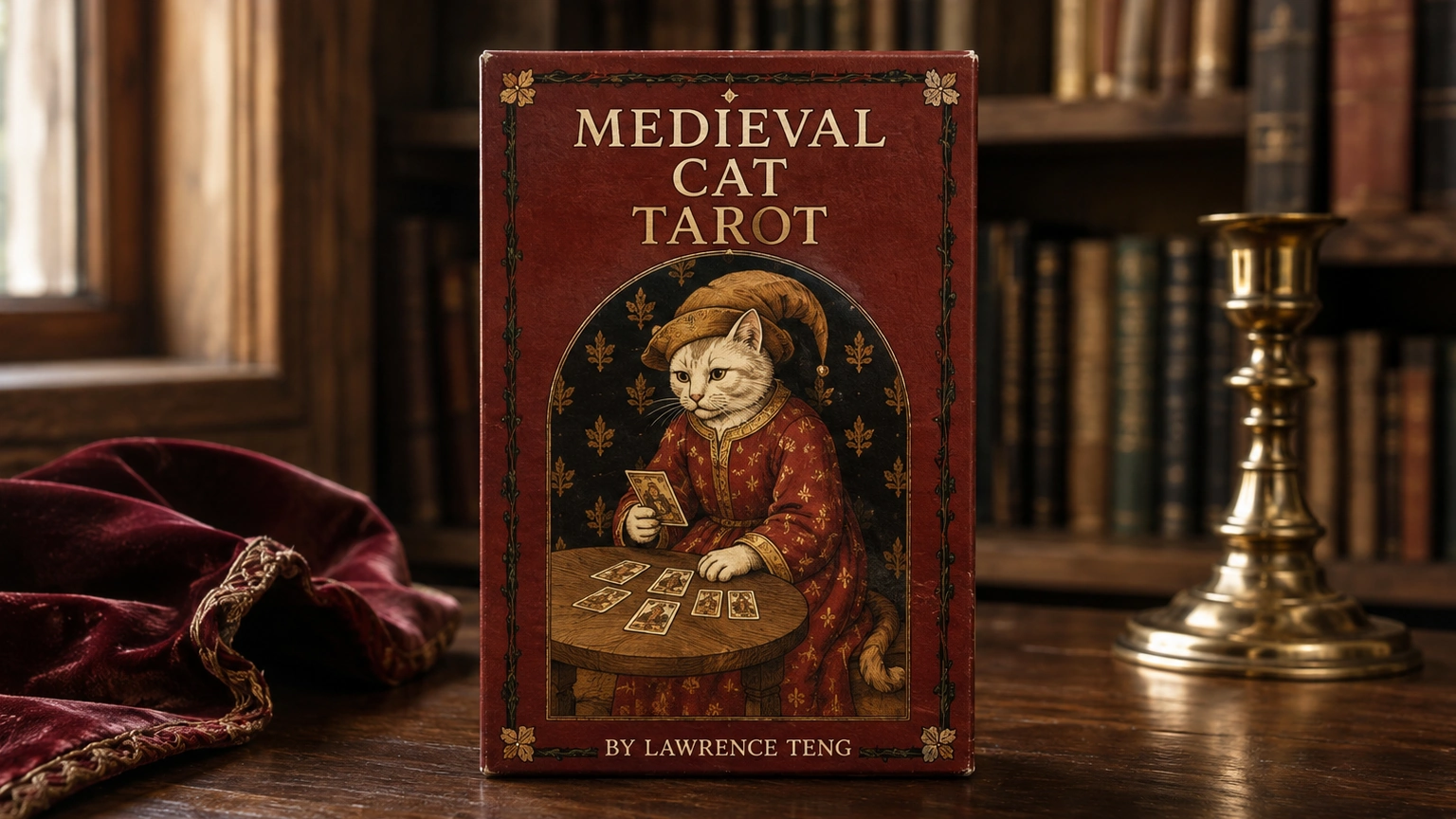
Look for the U.S. Games edition, the burgundy Medieval Cat Tarot box, Lawrence Teng’s name on the front, and ISBN 978-1-57281-476-9. Product photographs should match the cat reader in Renaissance dress.