Browse 55 verified Oracle of the Radiant Sun card images in a native TarotFans gallery. Tap any card to open a larger carousel view and study the deck’s vintage astrology symbolism up close.Oracle of the Radiant Sun Card Gallery
Quick Take: Oracle of the Radiant Sun Review
The Oracle of the Radiant Sun is an astrology oracle, not a normal 78-card tarot deck, and that is part of its charm. Caroline Smith and John Astrop built it around the Sun, Moon, Mercury, Venus, Mars, Jupiter, and Saturn moving through signs and houses. Each card gives me a keyword, a planet, a sign, and a small symbolic scene that can be read like a tiny story.
I like this deck most when I want a reading to name the weather around a situation. It is not the deck I would grab for a strict Celtic Cross with majors, minors, courts, and suits. Instead, it shines when I ask, “What pattern is active here?” or “What kind of energy am I stepping into?” Cards like Control, Risk, Secrets, Health, and Power do not hide behind soft language.
The art has an old-fashioned, sepia-pastel mood, with small scenes that reward slow looking. The native gallery shows 55 verified card images, so this review keeps the visual count honest instead of pretending the archive is complete. That is still enough to understand the deck’s voice clearly: astrological, direct, elegant, and a little strange in the best way.
Card Study: Discovery
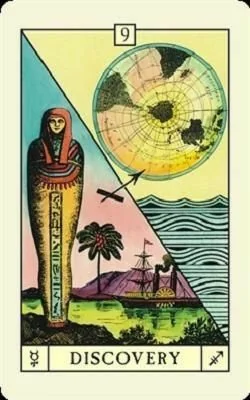
Discovery is the first bright clue. It does not promise that everything is solved. It says a door has opened and the mind is awake enough to notice it. In a reading about school, work, research, or a new spiritual practice, I would read this as curiosity becoming useful.
If the question is about love or friendship, Discovery can show a new side of someone being revealed. My advice with this card is simple: stay observant, ask better questions, and do not rush to a final judgment. The clue matters, but it is only the beginning.
What This Deck Feels Like in a Reading
Reading with Oracle of the Radiant Sun feels different from reading with a picture-heavy tarot deck. I do not start by matching a card to The Lovers, The Tower, or the Ten of Cups. I start with the keyword and the planet-sign mood. A card like Discovery feels fresh and mentally bright. Endurance feels slow, serious, and steady. Flattery instantly asks whether charm is sincere or being used as a mask.
That makes the deck very useful for personality readings, timing questions, emotional climate checks, and repeated patterns. It can show where someone is pushing too hard, hiding information, trying to keep status, or needing a cleaner structure. Because the cards are compact and keyword-led, I find they work well in small spreads. Four cards can already tell a complete story.
Four-Card Moment: Starting a New Path


This four-pack reads like a smart launch: notice the chance, use what you already have, focus your attention, and then build something real. I would use it for study plans, small businesses, and creative projects that need confidence without chaos.
Beginners can use this deck, but I would not call it a beginner tarot. You do not need to be a professional astrologer, yet a little astrology knowledge helps a lot. If you know the basic feel of Mercury, Venus, Mars, Jupiter, Saturn, the Moon, and the Sun, the cards become much easier to read. If you do not, the keywords still give you a friendly doorway.
Artwork, Symbols, and Readability
The artwork is one of the biggest reasons I remember this deck. The scenes feel like vintage book plates or tiny stage sets. They are not loud. They do not scream for attention. Instead, they use posture, costume, objects, and atmosphere. That is perfect for an oracle where one keyword needs to open into a full reading.
I also appreciate that the deck is not afraid of uncomfortable words. Quarrel, Manipulation, Submission, Criticism, Loss, and Revenge can sound intense, but in practice they help a reading become honest. Not every situation is soft, and this deck knows that. At the same time, cards like Friendship, Devotion, Fulfilment, Generosity, and Order give the system warmth and balance.
Card Study: Secrets

Secrets changes the room immediately. It may point to private information, unspoken motives, quiet research, or a feeling that someone is not saying the full truth. I would not always read it as betrayal. Sometimes secrecy is protection, privacy, or a process that is not ready to be shown.
In a career reading, Secrets can suggest hidden terms, office politics, or a need to read the fine print. In a personal reading, it asks me to respect intuition without becoming paranoid. The best question is, “What needs to be known, and what simply needs more time?”
The card size and border style make the deck feel more like a study tool than a glossy modern oracle. I would keep a notebook nearby. Pull a card, write the keyword, then write one sentence about how the image speaks to the question. That simple practice makes the deck much deeper.
Four-Card Moment: When a Relationship Needs Honest Air


This moment begins warmly, then asks for honesty. Friendship and Devotion show care, while Flattery and Secrets ask whether praise is covering something unsaid. It is a good spread for gentle but direct relationship reflection.
Who I Think This Deck Is For
I would recommend Oracle of the Radiant Sun to readers who enjoy astrology, vintage art, keywords, and compact spreads. It is especially good for people who want an oracle that feels intelligent instead of sugary. The deck can be warm, but it is not fluffy. It is more like a wise old almanac with pictures.
It is also helpful for tarot readers who want to add an astrology layer to readings without using a giant textbook every time. You can pull one Radiant Sun card beside a tarot spread to clarify the mood. For example, a tarot card may show a choice, while Radiant Sun’s Decision, Indecision, Caution, or Risk tells you what kind of choice it is.
Four-Card Moment: Pressure, Choice, and Personal Power


This is the deck at its sharpest. Someone wants control, caution is needed, a risk is on the table, and Power asks who gets to decide. I would read this slowly before signing, confronting, quitting, or making a bold move.
I would not choose it for someone who wants big cinematic fantasy art or a traditional tarot structure. This is a specialized oracle. If you meet it on its own terms, it has a strong voice.
Oracle of the Radiant Sun Pros and Cons
| What I love | What may not work for everyone |
|---|---|
|
|
Final Thoughts
Oracle of the Radiant Sun is a deck I respect more the longer I sit with it. It is not trying to be every deck for every reader. It has a clear lane: astrology, keywords, antique symbolism, and direct insight. When I want a reading to feel focused and patterned, it works beautifully.
Card Study: Order

Order brings the oracle back to structure. After all the drama of desire, risk, power, criticism, and secrets, Order says the next step may be simple: sort the pieces, make a plan, clean the system, and choose what belongs where.
I like this card for overwhelmed moments. It does not shame the mess. It shows that calm can be built through small, real actions. In a reading, Order often feels like the practical instruction at the end: make the list, set the boundary, file the paper, finish the ritual, or return to a steady rhythm.
Four-Card Moment: Recovering Balance After a Hard Patch


This one feels like repair. Name what was lost, leave the unhealthy pattern, care for the body and spirit, then rebuild order. It is simple, but it can be a very kind message after a stressful reading.
If you love classic tarot only, this may feel unusual at first. But if you enjoy astrology or want an oracle that can name the hidden mechanics of a situation, this deck is worth exploring. I would use it slowly, keep notes, and let each keyword become a doorway rather than a final answer.

Oracle of the Radiant Sun FAQ
Is Oracle of the Radiant Sun a tarot deck?
It is usually discussed by tarot readers, but it is more accurately an astrology oracle. It has 84 cards based on planets, signs, houses, and keywords rather than the standard tarot majors, minors, and court cards.
Who created Oracle of the Radiant Sun?
The deck was created by Caroline Smith and John Astrop. Their system uses solar astrology and symbolic scenes to turn planet-and-sign combinations into readable oracle cards.
Is this deck beginner-friendly?
It can be beginner-friendly if you like keywords and are curious about astrology. Total tarot beginners should know that it will not teach the normal 78-card tarot structure, because it follows its own oracle system.
What readings suit this deck best?
I like it for personality patterns, emotional climate, timing themes, relationship dynamics, career choices, and “what energy is active?” questions. It is excellent for short, focused spreads.
Does the deck require astrology knowledge?
You can read with the printed keywords alone, but astrology knowledge helps. Even basic meanings for the Sun, Moon, Mercury, Venus, Mars, Jupiter, Saturn, and the zodiac signs will make the cards feel clearer.
How many card images are shown in the TarotFans gallery?
The native gallery on this review shows 55 verified Oracle of the Radiant Sun images from the 84-card system. I keep that count honest while still reviewing the deck’s style and reading feel.