Tarot of Marseille Cards
Explore the verified CBD Tarot de Marseille artwork in traditional deck order. Select a group, then open any card for a larger carousel view. This is an honestly labelled partial gallery, so uncertain variants are never used to fill gaps.
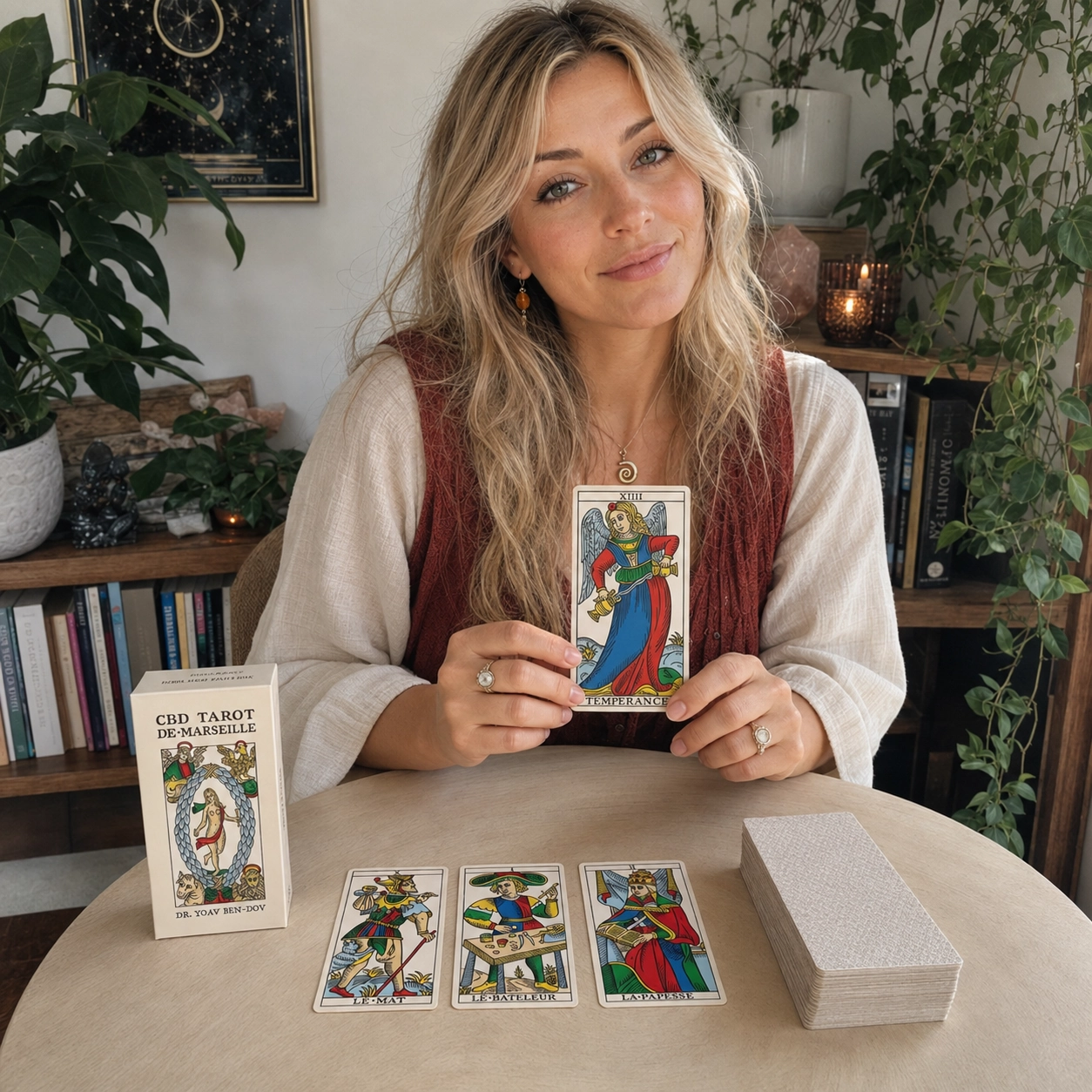
A note from Aurica
I love how Tarot de Marseille meets my eye without trying to soften itself. The red, blue, yellow, and green feel bright as painted shutters in summer, while the firm black lines give every gesture a little weight. I begin by noticing where a figure looks, what a hand protects, and which colour seems to call across the spread.
Temperance is the card I would place at the heart of this deck. Her two vessels make balance feel alive rather than perfectly still: something is always passing from one side to the other. In a reading, I ask what can be blended gently, what needs time, and where a quieter exchange might restore what force cannot.
The pip cards ask for a different kind of listening. I let the number set the rhythm, the suit name the part of life involved, and the arrangement show whether energy is opening, crowding, settling, or slipping away. Then I check that first impression against the cards beside it, so intuition has both roots and room to breathe.
I reach for this tradition when a question has become tangled in too much story. A small three-card spread can feel like opening a window: the pattern becomes visible, and the next practical step is easier to name. Beginners may need patience with the pips, but that patience soon turns into a wonderfully personal reading language.
This deck feels especially clear for relationships, creative choices, habits, and crossroads where honest structure matters more than reassurance. Its honest lines help me set aside noise, notice the living pattern, and name one kind next step. With patience, these old images can become a bright, steady language that reminds you how wisely your own intuition can speak.
Tarot of Marseille is one of those decks that feels ancient and direct at the same time. The art is not trying to be soft, cinematic, or modern. It gives you bold lines, primary colors, pip cards, and symbolic scenes that ask you to read with attention. If Rider-Waite-Smith decks feel like illustrated stories, Marseille can feel more like a wise old pattern book: plain at first, then surprisingly deep once your eyes slow down.
This TarotFans review uses a verified same-deck partial gallery: 69 card-front images recovered from the TarotFans Tarot de Marseille source board. The page keeps the count honest instead of filling the missing cards with similar but unsafe Marseille variants. That matters with historical decks, because small changes in color, title language, facial style, and suit layout can belong to different printings or different Marseille traditions.
Why Marseille Still Feels So Fresh
Tarot of Marseille is not a deck that tries to charm you with softness. It is bright, square-shouldered, and symbolic. The majors feel theatrical, while the minors ask you to work with number, suit, rhythm, and direction. That can be a little intimidating if you are used to scenic minors, but it also makes the deck wonderfully flexible. It does not lock every card into one emotional scene. Instead, it gives you a pattern and asks you to join the reading.

Card study: The Fool as honest movement
The Marseille Fool is not polished or posed. He is moving, carrying only what he can take with him. In readings, that makes him useful for starts, exits, experiments, and moments when you know the next step before you know the whole plan. He can be playful, but he is not careless by default. In this deck, The Fool often says: begin cleanly, keep your senses awake, and do not confuse fear with wisdom.
Who This Deck Is Best For
Choose Tarot de Marseille if you like traditional symbolism, historic tarot systems, direct card reading, and decks that make you think. It is especially good for readers who want to learn number patterns, suit logic, and visual clues instead of relying only on illustrated scenes. If you enjoy asking, “What is the structure underneath this situation?” Marseille gives you a very strong language for that.
Beginners can use it too, but it helps to be patient. The pip cards are simpler than modern scenic minors, so you learn by combining suit, number, position, and intuition. Cups can speak about feeling and receptivity. Wands can show spark, pressure, and action. Swords can sharpen a question. Coins can ground it in body, money, skill, or real-world care. That learning curve can feel harder at first, then beautifully freeing once the structure clicks.
Try this spread
Classic four-step Marseille check


Use this when you need a plain, grounded answer: where you are beginning, what tool is in your hand, what would be fair, and what brings the whole situation back into balance.
Art Style and Reading Feel
The deck has the bright, woodcut-style look many people imagine when they hear “classic tarot.” Figures stand boldly, colors stay simple, and the minors use arranged suit symbols instead of full little scenes. That gives readings a clean rhythm: image, number, suit, question, answer. The mood is not dreamy or decorative. It is practical, old-world, and symbolic. You may notice that your readings become shorter, clearer, and less dependent on memorized guidebook paragraphs.
Because the artwork is so direct, tiny details become meaningful. A figure’s gaze can matter. A repeated color can matter. The space between suit symbols can matter. Marseille teaches you to read like a detective and a poet at the same time: notice the evidence, then let the pattern speak.

Card study: The Moon before certainty
The Moon in Tarot de Marseille feels mysterious without needing extra drama. It is useful when a situation is emotional, unclear, or full of mixed signals. Instead of forcing an answer, this card asks you to notice what repeats, what feels instinctive, and what needs more light before you act. For younger or newer readers, it is a great reminder that “I need more information” is a real answer.
How to Read the Pip Cards
The pip cards are the part that usually surprises modern readers. They do not show a tiny story scene for every minor. A Five of Cups may not show a sad person. A Seven of Coins may not show someone waiting by a plant. Instead, you read the suit objects themselves: how many there are, how they are arranged, whether the pattern feels open, crowded, balanced, blocked, or moving.
A simple way to begin is to give each number a mood. Ones start. Twos compare. Threes grow. Fours stabilize. Fives test. Sixes harmonize. Sevens complicate. Eights organize. Nines intensify. Tens complete or overload. Then let the suit decide where that number is happening: feelings, actions, thoughts, or material life.
Try this spread
Feelings without over-explaining


This four-card moment is good for emotions, friendship questions, crushes, or creative blocks. Read it as mood, opening, emotional wisdom, and the tempting options that may or may not be real.
Beginner Guidance
If this is your first Marseille-style deck, do not try to memorize everything at once. Start with one question and one card. Say what you literally see before you reach for a big meaning. Is the card crowded or spacious? Does it feel active or still? Which color catches your eye first? Then connect that observation to the question. This keeps the deck from becoming a history exam and turns it back into a living reading tool.
It also helps to compare majors and minors. A major can show the big archetype of the moment, while a pip card can show the daily behavior that supports or blocks it. That is where Marseille becomes practical. It may look old, but it is very good at showing what to do next.
Card study: Temperance as quiet repair
Temperance is one of the gentlest cards in this old-style deck. The image reminds you that healing is often a careful pour, not a huge announcement. For daily readings, it can point to pacing, emotional regulation, and the small choices that help two parts of life work together. When this card appears, ask what needs to be mixed slowly instead of forced.
Best Questions to Ask
Tarot of Marseille is excellent for questions that need clarity rather than decoration. Try asking, “What pattern am I repeating?” “Which part of this situation is practical?” “What is the fair next move?” or “Where am I making the answer too complicated?” The deck can be blunt, but it does not have to be harsh. Its simplicity can feel like a friend clearing the table so you can finally see what is in front of you.
Try this spread
Practical next move


For school, work, money, or a personal goal, this spread moves from spark to practice, then steady progress, then confident leadership. It keeps Marseille readings clear and useful.
Pros and Cons
| Pros | Cons |
|---|---|
|
|
Final Thoughts
Tarot of Marseille is a beautiful choice when you want tarot to feel old, sharp, and symbolic. It does not over-explain itself. Instead, it invites you to look carefully, ask better questions, and build meaning from simple pieces. This review keeps the gallery count transparent: 69 verified same-deck images are live, with missing cards left out rather than guessed. If you are curious about tarot history or want to strengthen your reading basics, this deck can become a steady teacher.

Tarot of Marseille FAQ
Is Tarot of Marseille good for beginners?
Yes, if you are willing to learn suit and number patterns. It may feel less instantly narrative than Rider-Waite-Smith, but it builds strong tarot fundamentals.
Is this the complete CBD Tarot de Marseille gallery?
No. This is a verified partial gallery, and missing cards are never replaced with uncertain variants from another Marseille edition.
What makes Marseille tarot different?
Marseille decks use older symbolic artwork and pip-style minor cards. Readings often focus on number, suit, direction, color, and archetype instead of fully illustrated scenes.
Does this review use the YouTube deck source?
Yes. The review keeps the assigned TarotFans YouTube walkthrough at the top and uses the matching TarotFans source board for the verified native gallery.
Who should skip this deck?
Skip it if you want very modern art, soft guidebook language, or scenic minor cards that explain every situation visually.