THE DOCUMENTED CARD GALLERY
Explore the Second Nature Tarot Cards
This gallery follows Jae Larson’s official elemental system and keeps the recovered exact-edition card fronts in deck order. A small end-run of Water cards was not clear enough in the surviving source to publish responsibly, so this is a documented selection—not a claim that every deck card appears here. Choose a group or open a card in the full-size Lightbox.
Showing every card documented in this gallery.
AURICA’S QUICK TAKE
A garden that remembers how to surprise me
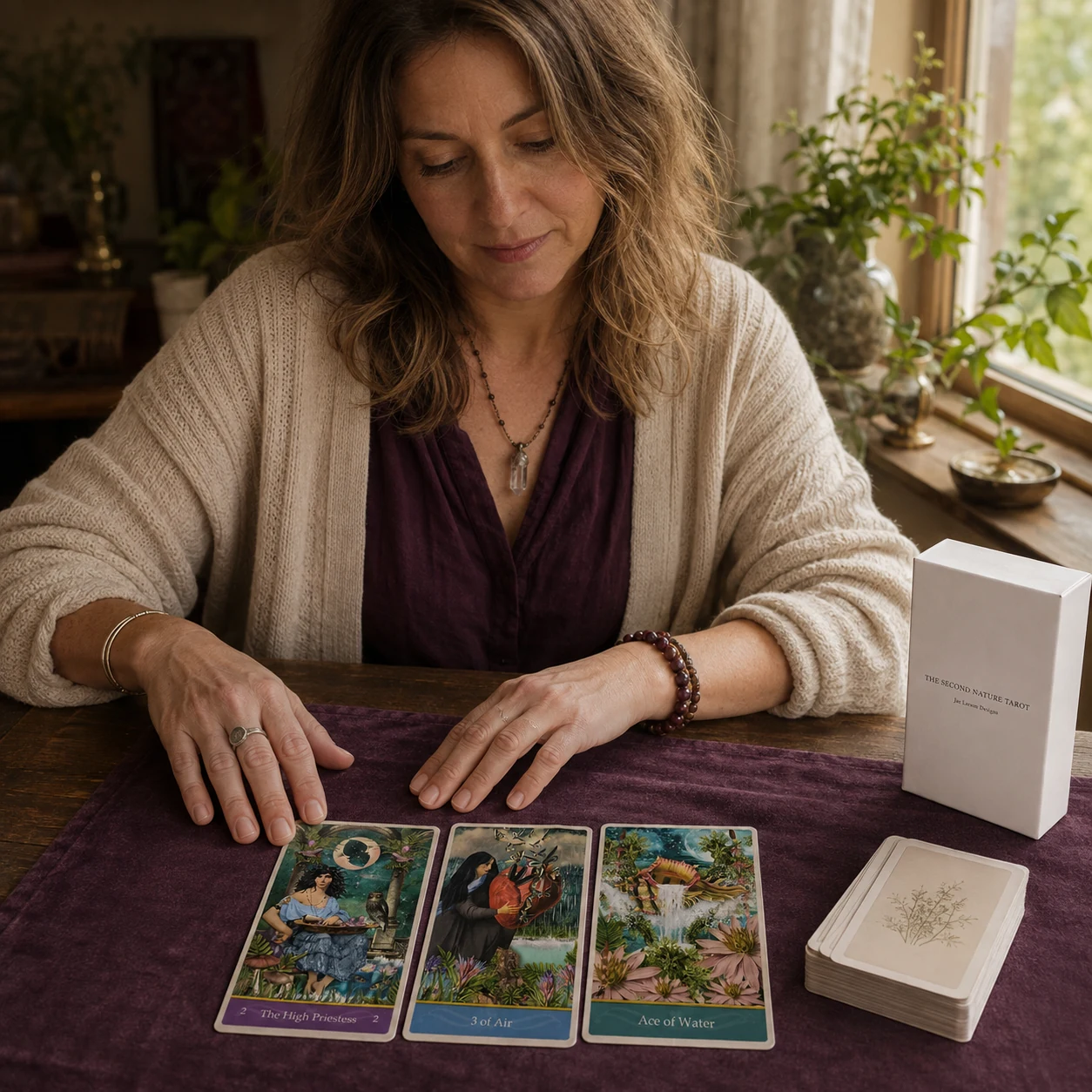
The first thing I feel with Second Nature Tarot is that the whole deck shares one night sky. Stars, ferns and mushrooms keep returning, so even a difficult card seems held inside a larger living world. I enjoy that continuity. It lets me move through a spread as though I am walking from one clearing to another rather than opening unrelated little pictures.
I read the living thing first. A bird tells me where thought wants to travel; a root shows what is feeding a situation; flame reveals what cannot stay dormant; water shows where feeling needs movement. Then I look at the coloured title strip and bring in the card’s traditional role. That order keeps the collage playful without making the reading vague.
This is the deck I would choose when a familiar question has gone stale. Its odd scale and vintage figures make me look again, and The Happy Squirrel keeps the mood from becoming too solemn. The cards remind me that insight can arrive through beauty, instinct and a perfectly ordinary moment of delight.
DECK IDENTITY
A bright, botanical collage tarot by Jae Larson
Second Nature Tarot is a self-published deck by Jae Larson of Jae Larson Designs. The creator describes it as loosely based on the Rider–Waite–Smith system, but its first impression is very much its own: vintage figures, animals and oversized botanical details inhabit teal skies scattered with stars. Ferns, mushrooms, flowers and crystals gather at the lower edge of many cards, making the whole deck feel like one continuous enchanted habitat.
Its title panels are colour-coded by element. Earth uses a warm brown, Air a clear blue, Fire a soft orange and Water a light aqua. The creator’s symbolism is equally direct: produce and flowers stand in for pentacles; birds, butterflies and feathers replace swords; torches carry the work of wands; and shells or sea life take the place of cups. That consistency makes the unusual imagery easier to read than its lush surfaces first suggest.
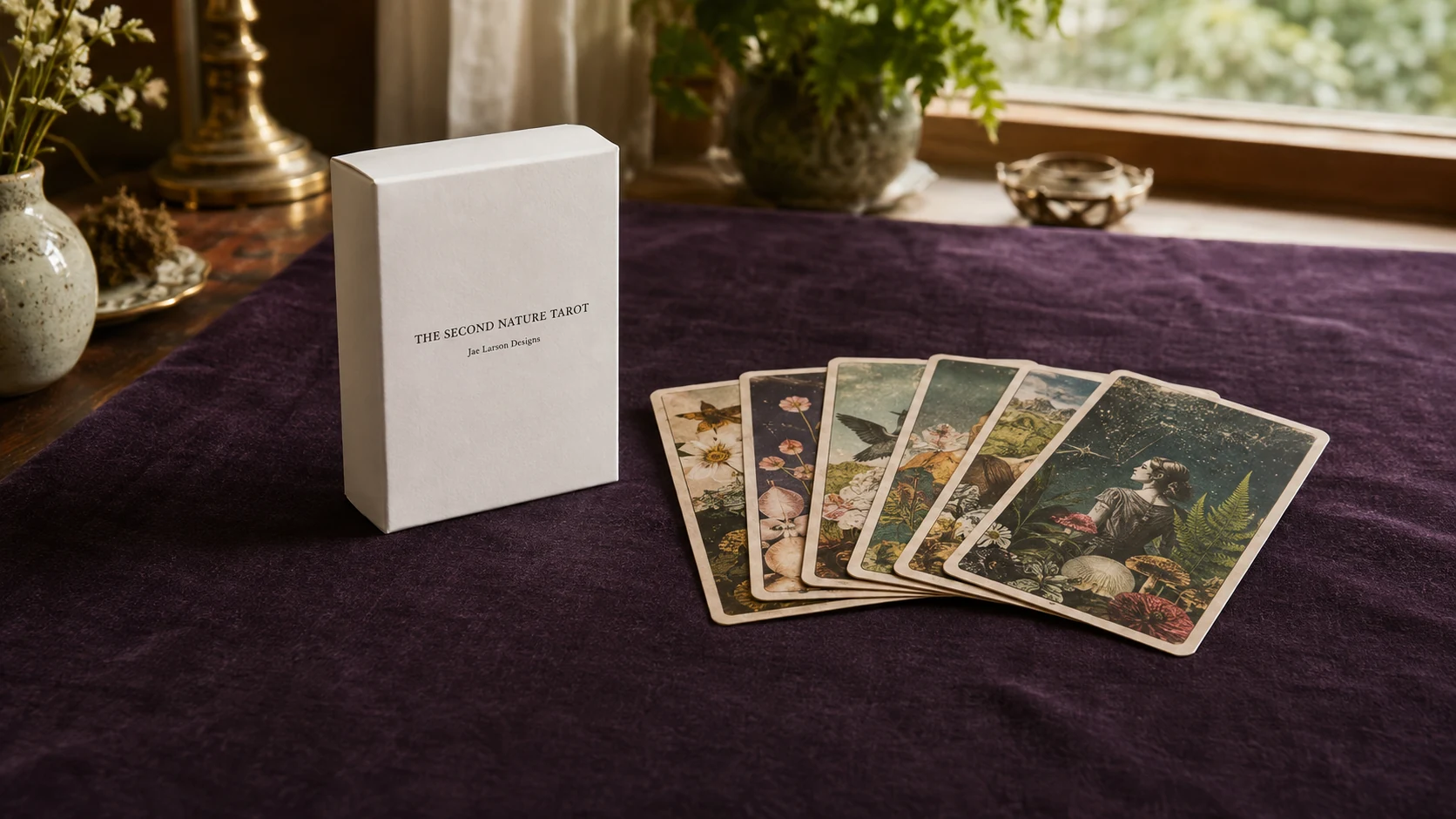
This review is deliberately exact-edition specific. The official page records tarot-size cards, linen stock, separate keyword cards, no definition booklet and a plain white tuck box. Current selling status varies across storefronts, so the links here lead to the creator’s information page rather than promising that a live copy is in stock.
CARD STUDY
The High Priestess: a still point beneath two faces
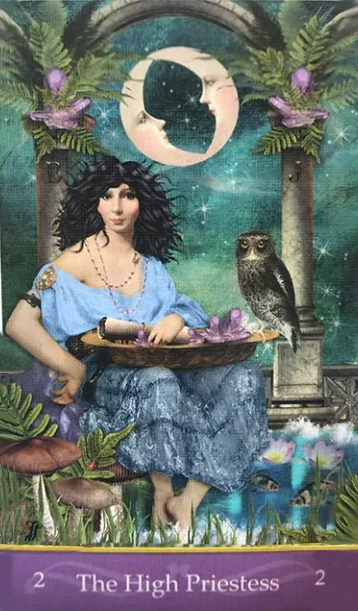
A woman in a blue dress sits between two stone pillars with a tray across her lap. An owl watches from one side, purple winged figures perch above, and a pale double-faced moon hangs in the arch. Ferns, mushrooms and luminous water crowd the threshold, but her direct gaze keeps the picture composed.
For me, the card’s wisdom lives in that contrast. The scene is full of possible messengers, yet the figure does not rush toward any of them. Upright, I read discernment, privacy and knowledge allowed to ripen. In shadow, the same stillness can harden into distance or waiting for a sign that has already arrived.
In a spread, name the quietest visual detail before reaching for a keyword. Then ask: What do I know when I stop asking the room to agree?
How Second Nature Tarot reads in practice
The deck gives you a strong first atmosphere. Teal skies, antique portraiture and dense plant borders make even difficult cards feel as though they belong to a living world. I begin by identifying the human or animal subject, then the suit emblem, then the direction of movement. That order stops the decorative abundance from becoming visual noise.
For daily pulls, try three lines in a journal: what is alive here, what is changing, what needs care. An Earth card may answer through roots, harvest or the body. Air often moves through wings and weather. Fire concentrates attention around ignition, risk and appetite. Water uses shells, marine creatures and flow to show feeling in motion.
Because the imagery is collage-based, scale is emotional rather than literal. A moon can hover close to a face, a shell can become a fountain, or a small human figure can stand beside an enormous creature. Ask what has been made larger than life and what has been made easy to overlook.
FOUR-CARD STUDY
Four elemental beginnings
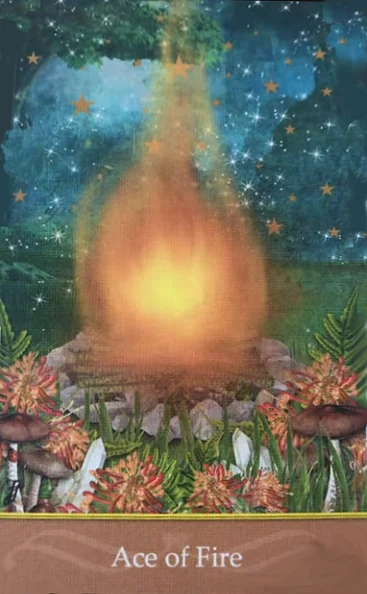
The Aces introduce the deck’s vocabulary with unusual clarity: roots, a bird, flame and a shell turn four kinds of potential into scenes you can almost touch.



Beginner guidance: use the colour and the emblem
A beginner can work with this deck, but it helps to know what has changed. Earth broadly takes the place of pentacles, Air of swords, Fire of wands and Water of cups. The courts become Child, Explorer, Lady and Lord. Write those translations on one page and the structure becomes familiar very quickly.
The separate keyword cards are useful for quick orientation, but they are not a full guidebook. If this is your first tarot, keep a Rider–Waite–Smith reference nearby. Let it explain the card’s traditional job while Larson’s image tells you how that job feels in this particular world.

CARD STUDY
Three of Air: the heart that releases its wings
A dark-haired figure holds an enormous red anatomical heart beneath a rain-heavy sky. Butterflies appear to emerge from the heart and rise upward while one black-gloved hand reaches across its surface. Bright flowers and ferns continue growing at the figure’s feet, so grief and vitality occupy the same card.
The familiar Three of Swords theme is present without literal blades. The visible wound becomes something held and witnessed, while the butterflies give pain a direction of travel. Upright, I read honest sorrow, release and the difficult intelligence of feeling. In shadow, the image can show clinging to pain because it has become part of one’s identity.
When this card appears, I ask: What needs to be felt fully enough that it can finally change form?
Love, work and creative readings
In relationship readings, the deck is strongest when you ask about emotional climate rather than certainty. Water can show what is shared or withheld; Air can expose the story built around a feeling; Earth asks what care looks like in practice; Fire shows the energy that keeps a bond warm—or consumes all the oxygen.
For work, the elemental translation is equally useful. Earth grounds resources and sustainable effort. Air clarifies communication, assumptions and strategy. Fire speaks to momentum and visibility. Water reveals morale, trust and unspoken needs. In creative readings, choose one card for the seed and another for the habitat it requires.
I would avoid using these images to make medical, legal or financial predictions. Their gift is reflective language: they help name patterns, priorities and choices. The final decision remains with the reader.
FOUR-CARD STUDY
The court as a living ecosystem
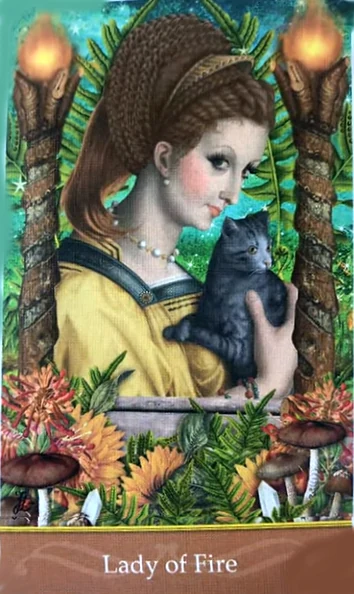
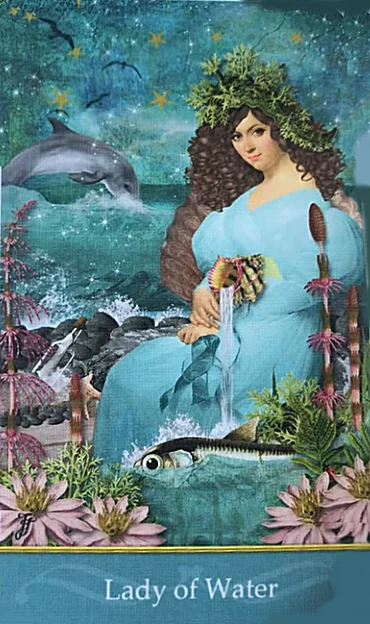
Across the four Ladies, authority changes texture: material abundance, mental alertness, creative heat and emotional depth each have their own posture and environment.


The four suits, one continuous garden
Earth is the easiest suit to ground: fruit, vegetables, flowers and roots make consequence physical. Notice what is ready to harvest and what still needs time below the surface. Air brings birds, wings, feathers and movement. It can feel gentler than a field of swords, but clarity can still cut.
Fire centers torches and flame among fire-bush plants, crystals and mushrooms. It is excellent for questions of courage, ignition and sustainable momentum. Water uses shells, sea life, fountains and open water. These cards often show feeling as an environment rather than an object you can contain.
The creator’s colour-coded title areas are a practical reading aid, not just decoration. If a large spread feels busy, scan the bottom borders first. You will see the elemental balance before your eye returns to individual scenes.
CARD STUDY
The Happy Squirrel: permission to let delight count
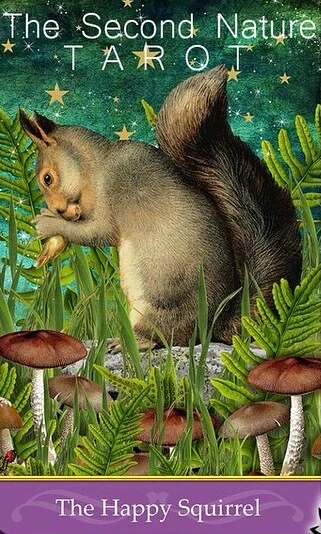
A large squirrel sits among bright ferns, grasses and red-capped mushrooms beneath the deck’s familiar starry teal sky. It holds a small morsel between its front paws and looks absorbed in the immediate pleasure of eating. The title panel is purple, separating it from the four elemental suits.This is the deck’s playful extra card. Its origin is a tarot in-joke, and Jae Larson’s official page says it is included “for fun.” I would not force it into a rigid inherited meaning. In a reading, it can be permission to notice delight, resourcefulness, appetite or the humble task directly in front of you.
Ask: What simple good thing is available now, before I turn the moment into a grand lesson?
Who will love this deck—and who may not
Second Nature Tarot suits readers who enjoy botanical collage, vintage figures, animals, elemental symbolism and a touch of absurdity. Gardeners, mixed-media artists and intuitive readers may find the recurring habitat especially inviting. It also works well for people who want a recognizable tarot skeleton without another close visual copy of Rider–Waite–Smith scenes.
It may be less comfortable for readers who prefer spare compositions, literal scenic pips or extensive companion books. Some figures and motifs carry a deliberately assembled, dreamlike scale. If you need every symbol to have one fixed definition, the deck can feel too open. If you enjoy asking how unrelated pieces create one emotional sentence, that openness becomes its strength.
The physical cards are officially described as tarot size on linen stock. That is helpful to know if hand comfort matters: the surface should offer some texture, while the larger format gives the collage room to breathe. The trade-off is that a full spread asks for more table space.
FOUR-CARD STUDY
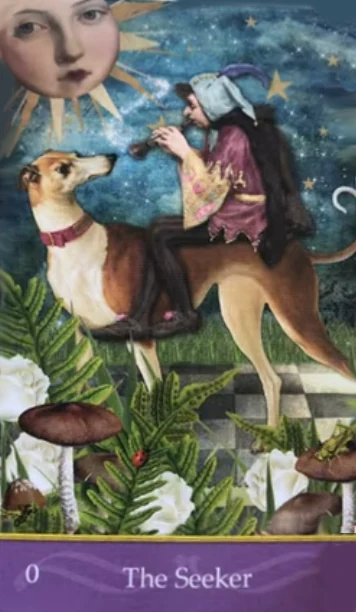
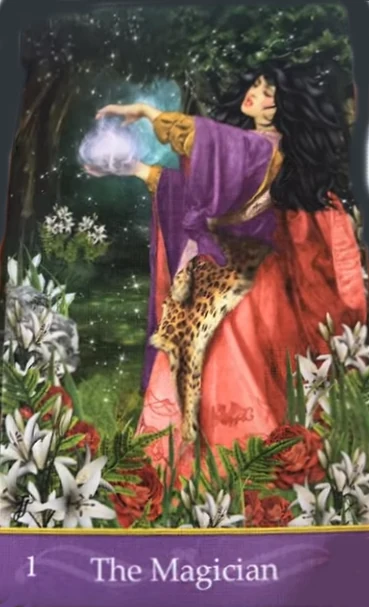
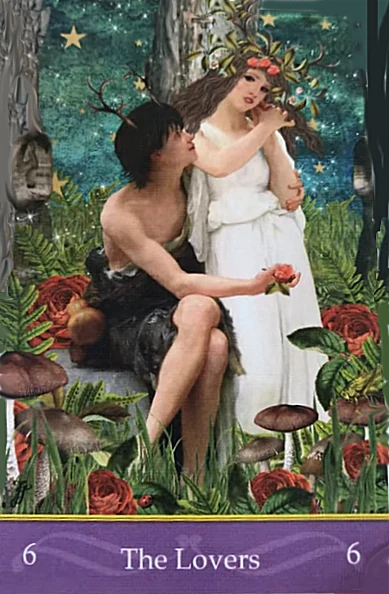
A walk through the enchanted threshold
These Majors move from curiosity to skill, relationship and inward listening while keeping the same stars, leaves and watchful creatures in view.

A four-card “second nature” spread
Use this spread when a habit feels automatic and you want to decide whether it still belongs to you.
- The root: What need or experience first grew this pattern?
- The weather: What currently strengthens it?
- The wild creature: What instinct is trying to protect me?
- The new path: What small, repeatable action can become a kinder second nature?
Read the four pictures as one landscape before separating them. Look for repeated animals, colors, directions and plant forms. If one element dominates, ask whether the situation needs more grounding, clearer thought, warmer action or emotional space.
Buying guidance and the exact-edition check
Jae Larson’s official deck page identifies a tarot-size linen-stock edition with separate keyword cards, no definition booklet and a plain white tuck box. The official marketplace listing we checked describes a larger card total because it includes separate reference cards, while the reading deck itself follows the familiar tarot structure plus The Happy Squirrel. Those are different counts for different things, and they should not be collapsed.
Availability is the main caution. The creator’s page says decks are offered through linked shops, but the exact direct marketplace product page currently reports that the designer has stopped selling that item. Before paying, confirm the seller, card imagery, plain-box packaging, dimensions and whether the keyword cards are included. Do not assume that another deck with the same title is this edition.
That sequence keeps Larson’s botanical world active without letting beauty float away from the question.
Final thoughts
Second Nature Tarot feels like a cabinet of natural wonders opened beneath a night sky. Its plants are not background filler; they make growth, decay, shelter and appetite part of every reading. Its animals can be companions, witnesses or instincts. Even its oddest extra card reminds us that tarot has room for humor.
I would reach for it when a question needs imagination without losing structure, especially around habits, creativity, emotional weather and the environments we build for ourselves. It is not a deck that needs to shout. Follow the fern, the wing, the flame or the shell, and the practical thread usually appears.
 View Second Nature Tarot Details
QUESTIONS, ANSWERED
Second Nature Tarot FAQ
Who created the Second Nature Tarot?
Second Nature Tarot is a self-published deck designed by Jae Larson of Jae Larson Designs. The creator’s current official page describes its imagery, elemental suits, materials, packaging and reference cards.
Why does Second Nature Tarot have an unusual card total?
It uses the familiar tarot structure and adds The Happy Squirrel as a playful extra card. The creator explicitly says that this bonus card is included for fun.
Is every Second Nature Tarot card shown in this gallery?
No. This page publishes only the exact-edition fronts that could be recovered and checked clearly from the source. A small final run of Water cards is not shown rather than being replaced, guessed or relabelled.
What are the suits in Second Nature Tarot?
The four suits are Earth, Air, Fire and Water. They correspond broadly to pentacles, swords, wands and cups, while the court sequence is Child, Explorer, Lady and Lord.
Is Second Nature Tarot good for beginners?
It can be, especially for a visually intuitive beginner. Its Rider–Waite–Smith roots provide an anchor, and separate keyword cards offer quick reference, but there is no definition booklet, so a fuller tarot guide is useful while learning.
Can I still buy this exact edition?
Availability is inconsistent. The creator’s official page links to Jae Larson Designs shops, but the exact marketplace listing we checked currently says the designer has stopped selling that item. Use the official details page to confirm current options and packaging before ordering.
KEEP EXPLORING
More Tarot Decks to Discover
Six more imaginative decks for readers drawn to enchanted gardens, collage, dream logic and expressive visual worlds.