Explore the North Atlantic Tarot Cards
Browse all 78 verified first-edition card fronts in Lee Thomson’s official order. Use the printed groups—Major Arcana, Shells, Bones, Feathers, and Stones—to filter the continuous gallery, or select any card to open the full-size Lightbox.
Showing the selected card group.

Aurica’s Quick Take
My verdict: this is a tender, materially intelligent deck for readers who notice texture before symbolism. Lee Thomson’s stitched currents, small found objects, and North Atlantic wildlife make the familiar tarot sequence feel handmade, weathered, and alive.
I would choose it for reflective journaling, seasonal check-ins, grief work, creative recovery, and readings about belonging. The pip cards remain readable because their repeated objects create rhythm, while the Major Arcana often land through posture, scale, and habitat rather than theatrical human expression.
Begin with what the card is physically doing. Is the creature surfacing, nesting, watching, carrying, or moving into open water? Then notice what the materials suggest: a loose thread can be a route or a snag; a shell can protect or amplify; a bone can be structure, memory, or what remains.
The deck does not hurry its answers. Give the images a quiet minute, let one texture or creature become your thread, and trust the small honest detail that keeps calling your eye. This is a beautiful companion for finding steadiness, courage, and a little more room to breathe.
A hand-stitched ocean world
North Atlantic Tarot review — at a glance
Tarot of the North Atlantic is a 78-card independent deck created by Scottish textile artist Lee Thomson. Each card turns cloth, thread, buttons, beads, shells, bones, feathers, stones, and found natural objects into a miniature shoreline tableau. Puffins, whales, seals, octopuses, seabirds, and weathered coastal relics replace conventional courtly scenery without losing tarot’s emotional architecture.
The result feels less like a painted deck than an archive gathered from a beach after a storm. It is gentle in texture, direct in mood, and unusually good at making abstract questions physical: What is worn smooth? What is tangled? What has washed ashore, and what is ready to return to the tide?
What makes Tarot of the North Atlantic different?
Thomson’s textile practice is not a decorative skin placed over standard tarot scenes. Fabric is the deck’s visual grammar. Quilted lines become currents and weather systems; buttons serve as moons, bubbles, eyes, and points of balance; narrow bones and feathers create paths, bars, and thresholds. Because the materials retain their everyday scale, even archetypal cards feel close enough to touch.
The four suits are renamed Shells, Bones, Feathers, and Stones. Their identities are carried by recurring objects and coastal habitats rather than copied Rider–Waite–Smith costumes. The courts remain Page, Knight, Queen, and King, helping an experienced reader navigate the deck while learning its own ecology.

The Fool — a puffin at the shoreline
A puffin stands against bands of vivid fabric, close to the uncertain edge between land and water. The stitched setting makes departure feel practical rather than reckless: feet planted, horizon open, instinct awake.
In a reading, The Fool can describe the brave first step before certainty arrives. In shadow, it can ask whether curiosity has become avoidance of preparation. The card’s useful prompt is simple: What small beginning would let me meet the unknown without abandoning myself?
How this oceanic tarot reads in practice
The deck reads most clearly in three passes. First, name the creature or object and its action. Second, follow direction: thread, wings, waves, gaze, and the placement of found materials all move attention through the card. Third, compare textures across the spread. A hard shell beside soft cloth may describe protection meeting vulnerability; a feather beside bone may contrast possibility with duty.
The Tide-Line Check-In
Use this sequence when a situation feels changeable but you need a grounded next step.


Read the spread like one tide cycle: arrival, retreat, renewed orientation, and the mystery you do not have to solve today.
Let the tide settle before the next card
After the four-card check-in, pause over the image that feels quietest rather than the one that shouts. Notice where thread gathers, where a creature turns, and where the stitched water leaves open space. That small pause keeps the spread from becoming a list and lets its emotional current gather before The Star opens the next part of the reading.
The Star — regeneration beneath the surface
The Star appears as a pale sea anemone opening from a red center, surrounded by tiny shells and buttons. Instead of a distant celestial figure, hope becomes a living marine body: responsive, rooted, and able to open again after disturbance.
This Star favors gradual restoration over dramatic rescue. It asks which conditions help you unfurl—clean water, honest company, rest, a repeated practice—and whether you can protect those conditions long enough for trust to return.
Lee Thomson’s textile art and suit language
Photographic reproduction preserves a surprising amount of the original textile relief. You can see stitched contour lines, frayed edges, layered cloth, and small objects casting real shadows. Those details reward larger viewing, which is why the gallery uses the highest-resolution complete source set available from the supplied archive and opens every card in a full-size lightbox.
Color does much of the emotional work. Turquoise and sea-green bring air and movement; midnight blues suggest depth; ochre, bone-white, coral, and berry tones create small points of urgency. Repeated animals also become a private vocabulary: birds often widen the view, whales carry deep feeling, and shoreline creatures negotiate two worlds at once.
The Four Coastal Materials
Draw one card from each suit and let the material name shape the question.
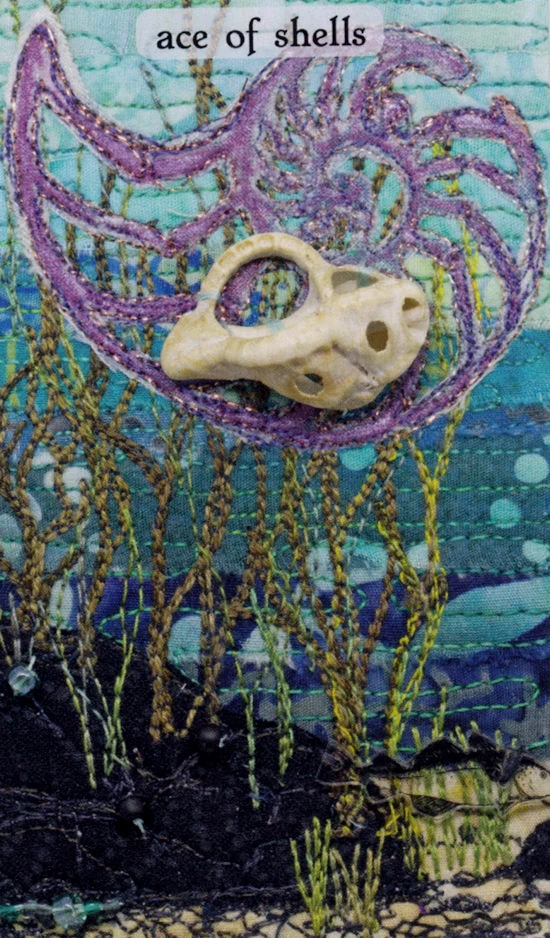
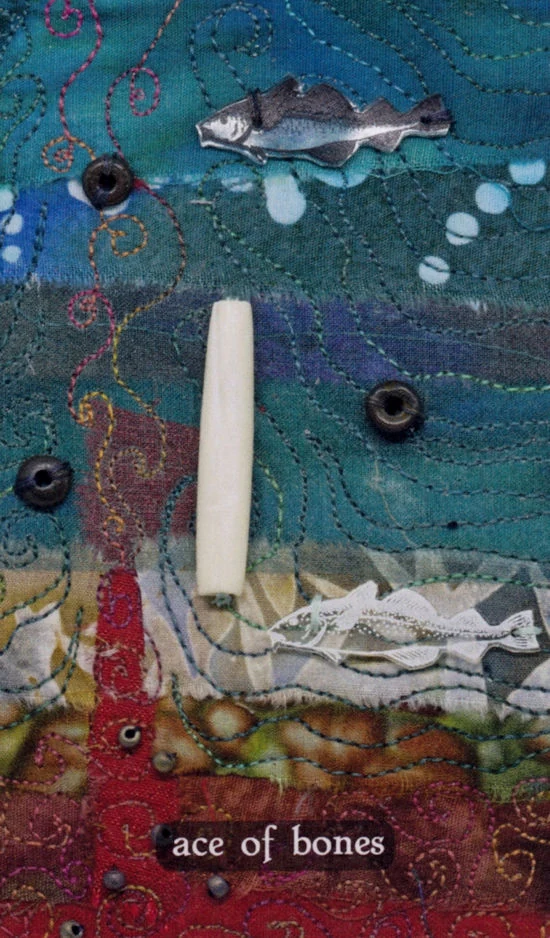
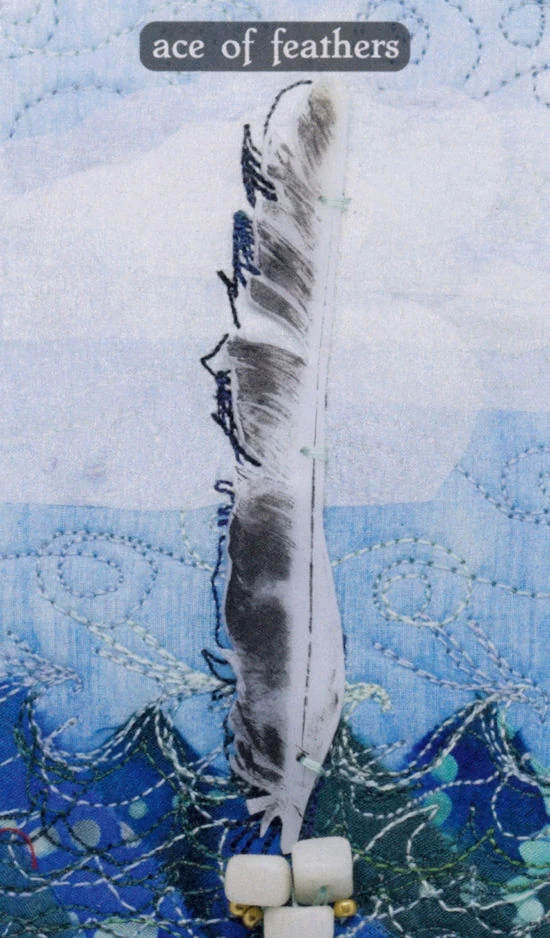

Finish by noticing which material feels most comfortable and which one you resist; that contrast often contains the reading’s practical advice.
Who will connect with this deck?
- Textile and mixed-media artists who want a deck where making, mending, layering, and found materials carry meaning.
- Nature-centered readers drawn to marine life, seabirds, coastlines, weather, and ecological imagery.
- Intuitive readers who prefer sensory prompts and visual association to fixed keyword systems.
- Collectors of independent decks who value a singular handmade voice and a regionally rooted concept.
Readers who need crisp graphic borders, highly conventional human scenes, or a readily replaceable mass-market edition may need more adjustment. The tactile photography also asks you to slow down; its meanings live in relationships between materials, not only in a central character.
North Atlantic Tarot pros and cons
Pros
- Complete 78-card structure with memorable renamed suits.
- Distinctive handmade textile art with real depth and material detail.
- Strong wildlife and coastal symbolism for intuitive readings.
- Consistent visual world that rewards journaling and card comparison.
Considerations
- The independent first edition is not as easy to source as a current mass-market deck.
- Some readers will need time to map Shells, Bones, Feathers, and Stones to their preferred elemental system.
- Subtle photographic textures benefit from good light and unhurried study.
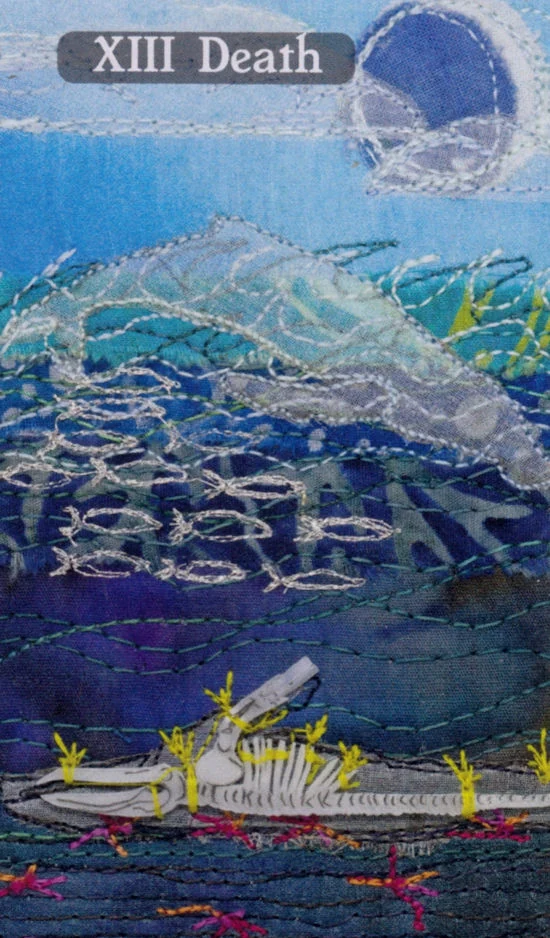
Death — what the tide leaves behind
Death uses the deck’s found-object language with particular force. Bone-white fragments, dark water colors, and stitched pathways make the card feel archaeological: transformation is not erasure, but a change in what can still be carried forward.
Upright, it supports necessary endings and the release of an exhausted form. In shadow, it can show clutching at remnants because they prove a former life was real. Ask: What can I honor without continuing to inhabit it?
A four-card reading for crossing rough water
For decisions that combine emotion and uncertainty, place four cards in a gentle arc: the weather around me, the resource already aboard, the current I cannot control, and the shore worth steering toward. Read repeated colors first, then compare which animals face one another and which turn away. End by turning the fourth card into one concrete action that can be completed within a week.
Buying and edition guidance
Tarot of the North Atlantic was a successfully funded independent project by Lee Thomson, with its first edition printed in 2018. The creator now records that first edition as sold out, and the exact MakePlayingCards product page says the designer has stopped selling it. Treat current copies as resale finds: compare any listing against the verified box art and complete card list shown here rather than relying on a generic “ocean tarot” title.
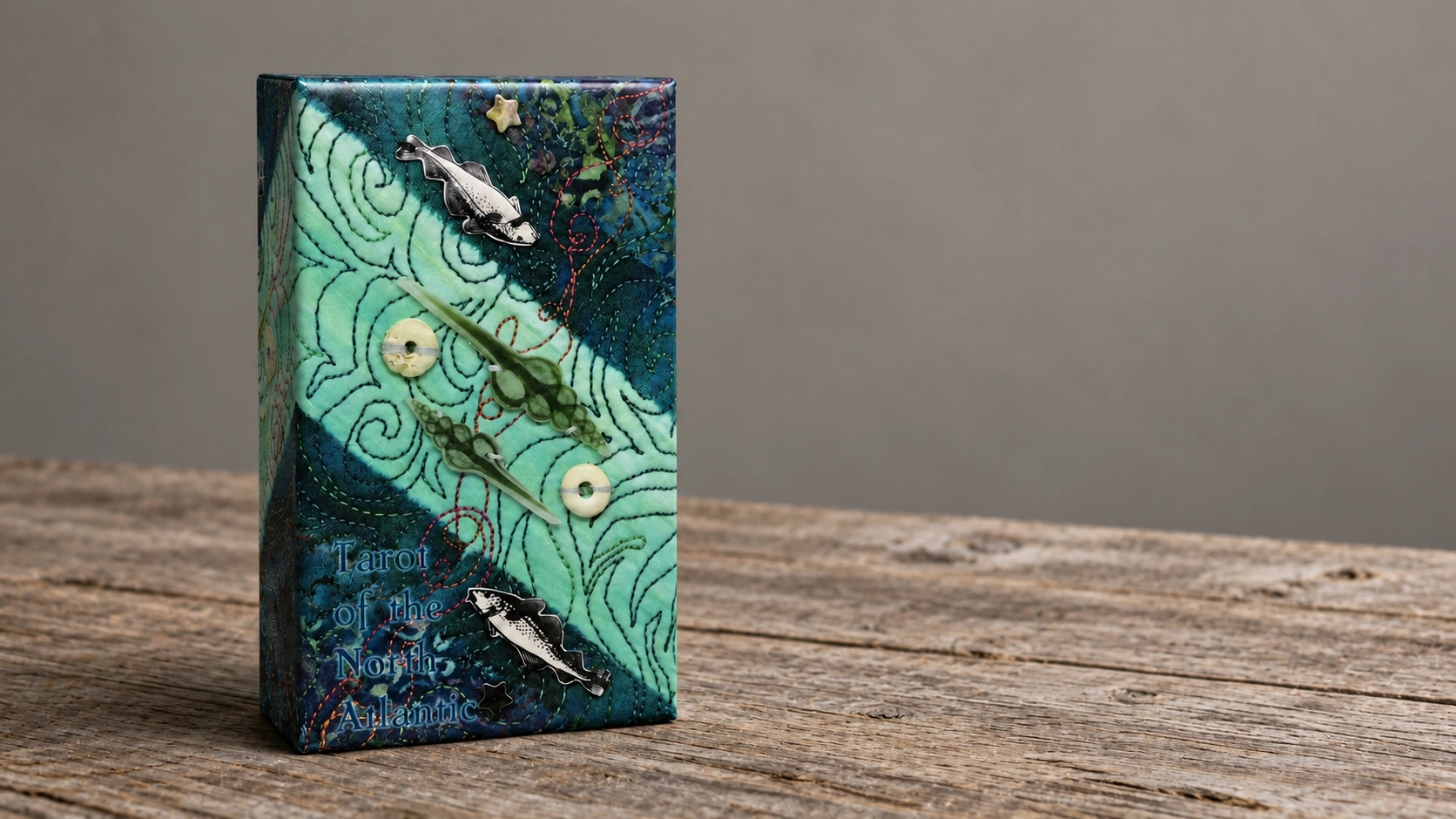
Before buying secondhand, confirm that all 78 cards are present, ask for photographs of the exact box and card faces, check whether the guidebook is included, and inspect corners for moisture or handling damage. The stitched fish-and-wave box design is a useful edition marker.
Final Thoughts
Tarot of the North Atlantic succeeds because its concept and materials are inseparable. Lee Thomson does not merely illustrate sea life; she builds a complete divinatory coastline from cloth and objects that have weight, age, softness, and resistance. The deck can be immediately charming, but its deeper strength is the way each tactile detail changes a reading.
If you want a tarot deck that feels observant, regional, handmade, and emotionally spacious, this one is worth lingering over. Explore the full gallery above, compare the repeated materials across suits, and let the imagery teach you its rhythm one tide at a time.
Amazon search results; check the deck and edition before buying.
Questions readers ask
North Atlantic Tarot FAQ
Who created Tarot of the North Atlantic?
Scottish textile artist Lee Thomson created the deck. She made 78 individual textile images using layered fabric, hand stitching, buttons, beads, shells, feathers, bones, stones, and other found materials.
How many cards are in the deck?
It is a complete 78-card tarot deck: 22 Major Arcana and 56 Minor Arcana cards. The four suits are Shells, Bones, Feathers, and Stones, with Page, Knight, Queen, and King courts.
Is North Atlantic Tarot beginner-friendly?
Its familiar 78-card structure helps, but the renamed suits and symbolic textile scenes ask for observation. A beginner who enjoys intuitive, nature-based reading can work with it successfully by describing visible materials and actions before adding traditional meanings.
Does it follow Rider–Waite–Smith imagery?
It follows tarot’s recognizable archetypal sequence but translates it into an original North Atlantic textile ecology. Many meanings remain accessible through posture, direction, repeated objects, and emotional atmosphere rather than copied Rider–Waite–Smith staging.
What makes the artwork unusual?
Every scene began as physical textile art rather than a flat painting or digital collage. Stitches become currents, buttons become celestial or organic forms, and found coastal materials carry meaning through texture as well as image.
Where can I look for North Atlantic Tarot?
Amazon search results; check the deck and edition before buying. Use the See North Atlantic Tarot on Amazon link to browse results.
Where can I see all 78 cards?
The TarotFans gallery near the top of this review presents all 78 verified card fronts in Lee Thomson’s official order, with accurate titles, suit filters, and a full-size keyboard-accessible lightbox.
More Tarot Decks to Discover
Continue with six oceanic, nature-led, and ecologically imaginative decks from the TarotFans library.
 Ocean Tarot Review
 Tarot of Mermaids Review
 Mermaid Tarot Review
 Second Nature Tarot Review
 Nature Spirits Tarot Review
 Navigators Tarot of the Mystic Sea Review